Showing posts with label water. Show all posts

Saturday, February 8, 2020

Anthropogenic Global Warming & the Garden!

Last year was pretty much a disaster, & this year has started in the same vein. The leaves of vegies burning in the sun, losing much of our fruit due to a warm winter, then the drought & running low on water & then the threat of bushfires. So, we have been making changes in the garden. We know that anthropogenic global warming is going to get worse, so we are preparing for the present & hopefully the future. Our grandchildren may not survive global warming, but hopefully we can help them survive teotwawki.

One of our galvo water tanks up at the cottage was leaking, so I cut it into three sections & made three raised garden beds. Whilst cleaning up the cottage garden area one of my sons decided to get rid of the old water tanks being used to store firewood, so that has produced another three raised garden beds. A small tank that I was thinking of repairing also got converted into two more smaller raised garden beds because we decided to install two more new 1000 gallon water tanks for the garden. We used to pump water from the big dam for the gardens at the cottage & the main house, but for the first time in 30 odd years, this dam became almost dry. We decided to preserve what was left for the local wildlife & for fire fighting if needs be. Fortunately though the fires were all around us & we were enveloped in heavy smoke for weeks, the fires never reached our forest.
Five tank raised garden beds & the sand pit for our grandchildren.
The first raised garden bed I made from old roofing iron & four posts.

My second design for a raised garden bed using pallets cut in half & old roofing iron.
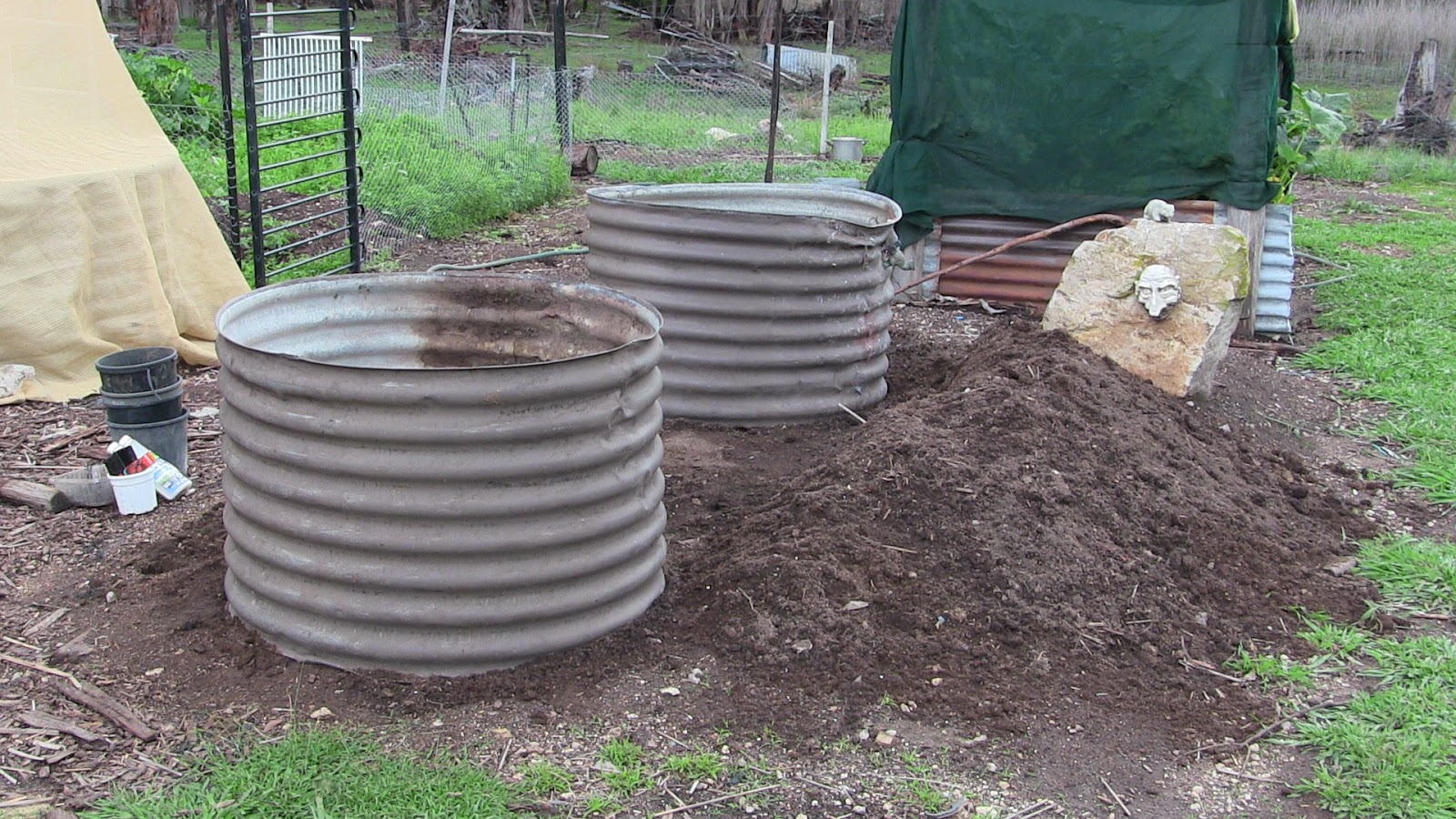
The latest raised garden bed additions, smaller but still useful. The advantages of these raised garden beds is that I think they will retain moisture better, they are easier to shade, easier to weed if needed, the bed is better secured & can not spread onto the paths, & it keeps the ducks out!!!
Well it's a bird bath right? And I am a bird right?

One new water tank on the left installed, we are still waiting on the second one to arrive. Since the drought everyone has been ordering more water tanks.
Keith.


Thursday, December 12, 2019

Climate Change Emergency is Real. Our very lives depend on us acting NOW!!!

This was Wychwood Forest some years ago, now it is dying. There is no longer any green grass & the wildlife is suffering. The trees are literally dieing from the heat & the lack of rain. On top of this we are now threatened by catastrophic bushfires. All this is caused by human made climate change. 

Long before the cattle industry, the world was populated with large numbers of ruminants, but the world seemed to have no issues with methane. American plains Africa and other continents had millions of buffalo, so how & when did the problem arise?
The world was a different place back then, large grassy plains managed by the indigenous peoples, huge wide spread forests, & healthy oceans. All these were producing oxygen & absorbing methane/Co2.
Then came the industrial revolution & the invasion of America & Australia. The industrial revolution marks the time steam engines were invented & coal was being burnt for energy. The invasions killed off many of the indigenous peoples & changed their lifestyles for ever. The grassy plains were no longer being managed to produce more green grass for the wildlife, now it was overrun by cattle & sheep. The forests were being logged for timber & destroyed & cleared to make more land for settlement & farming. The oceans lasted a little longer, but eventually humans also managed to pollute & contaminate with radio active waste, oil spills, garbage disposal, & single use plastics.
The herds of herbivores were mostly killed off & replaced with cattle & sheep in far greater numbers. The world was/is no longer green & the carbon dioxide levels rose & the oxygen levels in the oceans reduced. Now we have human made climate change, which is further destroying our forests through creating catastrophic conditions for bushfires. We have the internal combustion engine churning out Co2 into the atmosphere. We have coal burning electricity plants churning out more Co2 into our atmosphere. The planet is warming which is melting the ice & the permafrost. Melting ice has created black water which absorbs more heat. Melting permafrost is releasing more carbon into the atmosphere & releasing long buried pathogens & viruses.
Our world can no long keep up with the massive production of Co2 from livestock & other sources. The planet will survive when most, if not all humans have died due to climate change.
Keith.
The world's people, the Australian people, need to act now. If they do not take control of this human made climate change situation, then we may all quite possibly die in a mass extinction event!!! This is NOT paranoia, this is NOT sensationalising, this is NOT bullshit! This is REAL! If the people wait for someone else to fix this, they are going to find themselves trying to survive TEOTWAWKI, & after that possibly a mass extinction!
I have done all I can through popular media channels to warn the population about climate change global warming, apart from preparing my own home in the forest off grid to help my children & grandchildren survive, there is nothing else that I can do. You NEED to take control of your lives, you NEED to take control of climate change by stopping the burning of fossil fuels, & by stopping the logging & destruction of our native forests & woodlands. Your future & your children's future depends on it!!!
Keith.


Monday, December 10, 2018

What Is More Important To You, Your Present Lifestyle, or Your Life?


Frankly I can't think of any image or words that will convince the world of people that Climate Change is now an immediate threat to our lives on this planet. Only a minority of people give a damn, the majority either do not believe, or they assume someone else will save them, or they consider their present lifestyle more important than life itself! None of this makes any sense to me. The latest chart on Global Warming should be enough to shake everyone to the soles of their feet! By my estimation we may only have 30 years before the point of no return.

We can not as far as I can see turn the clock back, that in itself is bad enough. City dwellers may not realise how bad Climate Change is effecting us already, but those of us who live in the countryside are feeling & seeing these effects. If we do not take positive immediate action right now in 2019, then our chance of beating the deadline is most unlikely. Understand this, THIS IS AN END OF THE WORLD EVENT!  this is not fantasy, this is not bullshit. 

How many people are now thinking "if this threat was an actual fact, our government would tell us & would be taking measures to save this planet"?  Understand this: The Australian government & probably many other world governments are not focused on the future, their concern is today & how much money they can make personally. Your welfare, your well being, your lives do NOT matter to them. These politicians don't even care about their own families, their children, their grandchildren, their great grandchildren, their survival is of no concern to them, so why do you think they give a damn about you?

Don't take my word for any of this, do your own research if you want to survive, if you want your family to survive. Check out the chart on one of my previous posts on this blog (http://australiansurvivalandpreppers.blogspot.com/2018/12/seriously-end-of-world-is-in-sight-this.html) & work it out for yourself how much time you think we have left on this earth. Bare in mind that estimations are difficult, as the climate changes, the results speed up. Unlike the steady climate change in the past, now with human intervention everything is moving much faster. That is why we have to take action NOW, our time is very limited.
Keith. 


Saturday, April 22, 2017

Darwin couple rescued from WA desert. What To Carry With You When Going Bush.

The Darwin couple were saved from WA's Gibson Desert. Picture: AAP

Things/Items to carry with you at all times when going bush: (1) A good winch, preferably a hand operated winch. (2) A post hole shovel. This shovel can be used to dig yourself out by creating ramps from the bog. It can also be used to bury your spare wheel to use as an anchor for winching your vehicle out of the bog. (3) Plenty of drinking water. You can survive for up to 3 weeks without food if you are fit, but you can only survive 3 days without water. Hotter conditions and exertion will shorten the time you can survive without water. (4) Food. (5) A 4 litre container of engine oil. (6) Extra fuel. (7) A good medical kit. (8) Tool kit. (9) Wool blankets. My Father always carried a wool rug in his car. This was a carry-over from the days when our cars had no heaters. It is however still relevant, because deserts can get cold at night, and if it is winter it can get cold wherever you are in Australia. (10) A good tyre pump. We have an electric one. If purchasing an electric pump, make sure you get a good one. This is a classic case of "you get what you pay for"! (11) A "snap-strap". Just in case someone else comes along and is able to pull you out. (12) A high lift jack. We call them "wallaby jacks".

Sunday, February 26, 2017

Contamination in Australian water & foods.


(Click the web browser refresh button to see the latest reports. Date Formatting is Day/Month/Year - 11th March 2011 is 11.03.2011.) March 2015 - Tuna Contamination Report,
This incident reportedly happened six months ago, and unfortunately there was no available sample to test.
In late March I received this email from a contact who has a Geiger counter.
I have removed some information from the correspondence to protect the contacts anonymity.
“You have to watch your food like a hawk. My daughter had some tuna in oil….very small tin. I had been warning her. But dad is crazy. I found the tin going into the recycle, it still had a bit of oil in it. So, me being me, I got out my geiger counter and took a reading………it went ballistic.
It just keep climbing and climbing. I didn’t think it was going to stop……It stopped climbing when it hit 38K counts per minute….I didn’t know my bGeigie Nano meter went that high. The oil seemed OK, the tin seemed OK, but a tiny flake of leftover tuna the size of a match head was on the lip of the tin, that is what set it off. Don’t eat ANYTHING from the sea….anymore. That tuna was toxic radioactive nuclear waste, and not food.”
38K counts per minute would be around 1000 times background, using this model Geiger counter!
I sent this email to get more information on this very high detection.
Do you still have the sample?
If you are located in Australia, and still have the sample, I could test it, if you posted to me.
If you don’t have it, if you provide the information below, I may be able to source some here, and test it.
In what country was the tuna tinned?
In what country was it purchased?
Here is the reply to my email query.
This happened over 6 months ago.
I can only assume it was canned in the USA. tuna in oil. At that time I thought the reading was coming from the oil in the tin….I didn’t notice the flake that was on the outside top edge of the can. I got it stuck on my finger and washed it off. After this, is when I couldn’t get a reading from the tin or the oil again. I realized that the flake which was gone down the drain by then was the cause.
I thought my Geiger counter was malfunctioning at the time, which it never has before or since. The count was going up and it freaked out my son as we watched it climb. The highest reading I have ever gotten until then was 164 CPM off of a milled piece of pine, but at that time I was (and still am) learning how to use the geiger counter.
Comment:
A small number of tests on different brands of tinned tuna have been conducted here recently, and over the last couple years. There was nothing to report from these tests. This is only one community testing lab, and each test takes 24 hours, or more. A large variety of mainly Australian food products have been tested, so statistically the number of tinned tuna tests conducted here at this stage is very small.
It obvious more widespread community and government food testing needs to be conducted.
08.03.2014 - Proven: Pilliga groundwater contaminated by Santos CSG
Extracts:
Documents obtained by The Wilderness Society show that groundwater in the Pilliga has been contaminated by Santos CSG operations.
Uranium levels recorded in the groundwater as a result of CSG activities are at 20 times the Australian Drinking Water Guidelines.
The NSW EPA have confirmed the contamination event, but failed to act with any proper legal force, choosing to fine Santos only $1,500 dollars.
On Friday, EPA chief environmental regulator Mark Gifford confirmed the contamination was caused by water leaking from the pond and that lead, aluminium, arsenic, barium, boron, nickel and uranium had been detected in an aquifer at levels ”elevated when compared to livestock, irrigation and health guidelines’
Comment By Lock the Gate:
Uranium levels recorded in the groundwater as a result of CSG activities are at 20 times the Australian Drinking Water Guidelines. It is the nightmare that the communities of the north west dreaded, and we hope that the contamination is contained and does no harm. Groundwater is the lifeblood of towns and rural businesses and the worst fears of local farmers are being realised.
http://www.lockthegate.org.au/proven_groundwater_contaminatedhttp://www.smh.com.au/environment/santos-coal-seam-gas-project-contaminates-aquifer-20140307-34csb.html
26.09.2013 - Detection of Radon-220 in the rain
http://sccc.org.au/detection-of-radon-220-in-the-rain-september-2013
20.09.2013 - “Contaminated seawater reaches the east coast of Australia and Indonesia,” Japan Meteorological Research Institute.
Comment:
It is important to read the PDF presentation to fully understand the dynamics of this. (Link provided below)
http://fukushima-diary.com/2013/09/japan-meteorological-research-institute-contaminated-seawater-reaches-the-east-coast-of-australia-and-indonesia/http://www-pub.iaea.org/MTCD/Meetings/PDFplus/2013/cn207/Presentations/1028-Aoyama.pdf
09.09.2013 - Detection of radioactive Iodine I-129 in roof gutter moss Australia.
http://sccc.org.au/detection-of-radioactive-iodine-i-129-in-roof-gutter-moss-australia
October 2012, Impact on Australia from the Fukushima Daiichi nuclear power plant accident
1. Food imported from Japan, page 22.
2. Family living in Fukushima for 150 days, page 32.
3. Vehicles and Military aircraft, including American helicopters, page 28.  (They appear to be using measurements of square centimeters cm2 instead of per square meter m2, so multiply by 10,000 to get the Bequerel per square meter amount.)
4. Mutton Birds Tasmania, page 36.
http://www.arpansa.gov.au/pubs/technicalreports/tr162.pdf
11.09.2011 - Silent Storm atomic testing in Australia
Extracts:
Australia’s milk supply? From 1957 to 1978, scientists secretly removed bone samples from over 21,000 dead Australians as they searched for evidence of the deadly poison, Strontium 90 - a by-product of nuclear testing.
Official claims that British atomic tests posed no threat to the Australian people.
http://www.youtube.com/watch?v=vDOUeniCNKM


Tuesday, January 24, 2017

Lost Survival.


Lost Survival.
In an ordinary lost situation if you did the right thing & notified several people in regards to WHERE you were going & WHEN you intended to return, then all you have to do is sit tight & wait for someone to find you. This is of course providing you STOP as soon as you realise that you are lost, & do not stray too far from your intended route.
IF you feel that you have strayed too far from your intended route, OR you failed to tell anyone where you were going, then there are practicle things you can do to stay safe & perhaps find your own way out.
1) If you are low on water, find some if you can without straying too far from your present position. Low ground is generally better than high ground, though a rock plateau can often hold water in holes & basins in the rock. In flat terrain look for greenery growing. Usually this is trees or bushes. This could prove to be a water hole or a water course.
2) Remember that providing you keep yourself safe & have water, TIME is not an issue. Staying alive is more important than losing your job! Concentrate on staying alive & getting out, relax if you can & don’t panic.
3) You may need to construct a simple shelter from the sun or bad weather. With this goes making a fire, but make sure the fire is SAFE & can not spread! Clear an area of 5 paces all around your camp site, but only make fire if it is safe to do so. In extreme hot & dry conditions you should not light a fire.
4) During the day listen for the sounds of people; vehicle engines, car doors shutting, dogs barking, house doors closing, the sound of chainsaws or axes cutting wood or the sound of a generator or water pump.  Look for smoke from camp fires or house chimneys. This will give you a direction to follow, but make sure you do NOT go round in circles. Line up three trees or land marks or a combination of these in the direction you need to go. When you get to the first marker, put your back against it & line up the remaining two markers with another third one. Continue on & repeat.
5) At night listen for the same sounds, but unless they are close-by, just mark the direction with rocks or sticks or mark trees & wait until daylight unless you have a torch or are fairly certain you are on safe ground. Travelling in the dark can be dangerous & you do NOT want to injure yourself. Look for vehicle headlights, radio tower lights, house lights, camp fires, lighthouse lights if you are near the coast. Watch for aircraft lights, there may be an airstrip not too far away.  
Low ground can be good for finding water, but high ground will give you the best chance of seeing something that will help you get out. High ground will also make you more visible if you keep a fire going. Adding green vegetation to a fire will create more smoke. Passing aircraft may also spot your fire. 
THREE is the S.O.S. signal, three whistle blasts, three gun shots, three fires (keep them safe), three COOEEs (a shout), three air horn blasts, three flashes from a torch at night, three flashes from a mirror during the day. You get the idea.
IF all else fails, going down hill SHOULD eventually lead you to a water course/source. EXAMPLE: you are on high ground, you go down. When you reach the lower ground, say a valley or gully, it too should go downward in one direction. Follow this downward & continue doing this until you find a water course. Mountain areas at their highest points produce what is called "Header Streams". These are where the water source starts from & these eventually run into streams or creeks which eventually lead to lakes & rivers. Water is also a source of food, & communities are usually built close to a water source.
If you do not expend too much energy, you can survive roughly 3 weeks on water alone, no food. But you can only survive roughly 3 days without water.


Friday, January 6, 2017

What Not To Do!

I was prompted to write this short article because I recently saw a video about survival in Arnhem Land. In this video a number of suggestions were made that I do not agree with. Rather than rubbish the video or the presenter, I prefer to simply advise what not to do in this blog.
I lived for 10 years in the Territory, I survived cyclone Tracey in 74, & prior to that I lived in an Aboriginal camp in Arnhem Land for two months.
When travelling in the Territory, wet season or dry season, do NOT set up camp anywhere near water if you intend to spend the night there, & certainly not in shaded areas near water. The reason for this is: 
(1) mosquitoes breed in water, & they love to be near water & particularly swarm in shaded areas. The dry season can get chilly & therefore less mossies especially if there is a stiff breeze blowing, but in shaded protected areas the mossies are still there.
 (2) Leaches. Leaches love the damp, & they are not just in the water. Leaches can be found in the damp areas anywhere near water & you do not want these in your shelter. 
(3) Snakes. Snakes love the water & frequent low damp areas, this is where they find their food. They are also great swimmers & will often travel by water. If snakes are to be found anywhere, it will be near water.
(4) Crocodiles. Crocs are everywhere in the Territory, a safe water hole one season may not be safe the next, because during the wet season crocs travel overland. Crocs can be hard to spot in the water, & they will often leave the water. Crocs can also run very fast on land for short distances. If you don't want a croc dragging you out of your shelter at night then don't camp near the water! If you have to fetch water, NEVER put your hands in the water, NEVER stand on the water's edge. Use rope, cordage or at the very least your waist belt through the handle of a billy to dip water. Crocs are amazingly fast so take care! 
(5) Rising Water. In the wet season water holes, creeks & rivers can rise very quickly & if your shelter is too close to the water you can get flooded out. 

If you are going to make camp do it in an open area high & dry if you can with a tree or two for shade. In this way you can take advantage of any breezes blowing that will help keep you cool & hopefully keep the mossies at bay. Sometimes there is no escaping mossies, I have covered myself with a blanket, used a mossie net, & sat all night by a Buffalo dung fire drinking rum all night. The latter won't keep the mossies off, but after half a bottle of rum you don't really care! Come morning though you will not be feeling so good from the rum or the mossie bites!
You take care out there.
Keith.


Wednesday, December 28, 2016

Bugging Out. Carrying all that weight.


You can travel light and carry all you need for long term wilderness living/survival, all that is accept perhaps enough water and food! If there are water holes on your route then there is no problem. If you are able to hunt & forage on the way then there is no problem. But what if you get diverted have to by-pass those water holes? What if you are trekking in winter and there are few edible plants to find and the game is scarce? Then you have a problem. You can survive for three days without water, but this also depends on how hard you are working. You can survive three weeks without food, but again, this is dependent on your exertion level. You probably know as well as I that when you are working hard your need for water and food increases. You are drinking all the time to stay hydrated and come lunch time you are very hungry. To go without water and food is dangerous, because the lack of water and food effects how you perform, mentally and physically. One minute you think you are doing fine, the next minute you are feeling sick. Keep going and you will collapse.

Sharing the load with a partner is fine, you can carry the shelter, kettle, arms and ammunition, your partner can carry the water. But water is heavy, and to be safe and practicle your partner also needs to carry at least some of her/his own equipment. Simply put, you can never really carry enough water for a long trek unless you can find a water source along the way to refill your water bottles. Even then to be safe you will need to stop and boil that water before you can drink it.

So what is a simple and practicle alternative? Using a trekking trolley. A trekking trolley can carry a lot of weight, and there is a wide variety of different trolleys to suit your needs. On a level surface pulling a trolley is easier that carrying a heavy load, but going uphill you will need to pace yourself. Even so, when you stop for a rest on the trail and take a drink of water, you are not still bearing that load. If you are travelling with a partner or a group, you can use a rope to link you to another trekker who can help pull the load up steep inclines. If you can afford it, you can purchase a trekking trolley, if you don't have the funds, then you can make your own without too much trouble.
An Australian made trekking trolley.

A trekking trolley that the author made from old wheelbarrow parts and bush timber. This one only has one wheel, but the author plans to make another one from an old golf trolley.

When you reach your destination this trolley will still be of use, and can be used for: transporting game, transporting water from a water source, carrying firewood, transporting rocks for a fireplace, moving camp if needs be. Perhaps you can think of further uses?
Keith.

Disaster Preparedness for the Apocalypse: How to Prepare for any Disaster.

Cyclone Tracey 1974 Darwin Australia.


Friday, December 23, 2016

Comfort Equipment.

Comfort Equipment.
Definition of Paleolithic. Of or relating to the earliest period of the Stone Age characterized by rough or chipped stone implements. Merriam Webster Dictionary.
Humans have been surviving for thousands of years, back in the Paleolithic period life was hard, even so these people must have had some creature comforts, perhaps local flora placed on their beds to make it softer and keep them up off the ground. Tools were very basic being made of wood, stone bone, horn or antler, and yet these people survived.
Make no mistake, most of the equipment we carry today is for comfort, to make life easier, but we could survive as a people without the equipment we carry. Some items I deem essential, a good medical kit for instance. But as for the rest, no it is not a necessity, just a preference. So why all this modern so called “survival gear”? Does it add to our comfort? In some cases perhaps, but it also has drawbacks. Take the sleeping bag for instance. Great until it gets wet, then it will not retain as much of your body heat as an ordinary pure wool blanket! I am not going to list all the fancy gadgets here that are basically designed to attract people that like gadgets, people that have no real sense of what is needed to survive long term in a wilderness situation. But I would like you to think about this. Every time you add a piece of equipment to your pack, ask yourself these questions: Do I need this? Is this piece of equipment sustainable? If it breaks can I fix it? Will this piece of equipment serve a needed purpose, or is it just taking up room where I could be carrying something else that is more important, such as water, food and ammunition?

Think about the tools that you carry or are about to purchase, think about their purpose. The knife, what is it used for? Skinning and butchering game, and for defence; Is the blade long enough for defence use? Can I kill with this blade or is it too short? The axe, used for many tasks that involve the cutting and shaping of wood as well as for defence and possibly needed for hunting. How easy would it be to replace a broken helve? How heavy is it? Can I use the poll as a hammer to drive stakes into the ground? And so on and so on. Your equipment needs to be versatile & sustainable, it needs to be able to perform the function that it’s namesake was originally designed for. Paleolithic flint knives were not used for cutting down small trees; they made flint hand axes for that purpose. In today’s modern world of survival equipment manufacturers seem to have forgotten this common sense approach that those primitive people in the Paleolithic took for granted. Think about that, your life may depend on it!
Keith.
By David Wright.

Sunday, February 14, 2016

If or When TSHTF. Part Six. Going Bush. Gardening & Construction Tools.


Gardening and Construction Tools.
When moving out bush with a view to long term living you need to have some idea in your head as to the type of area you are looking for. You will need permanent water if possible, a creek or a river. This may also supply reeds for shelter construction & other items. A cave would make a great shelter or even a rock shelter, but if these are not available at your water source then you will have to construct shelters.
These types of tools are generally bulky & heavy, but they can also double as weapons if you have people to carry them. Helves, handles & stails can be removed from the heads & the heads can be carried in a pack if this is easier than carrying the complete tool. Think carefully about the tools you will need. In a long term wilderness living situation you will need to produce gardens & construct shelters.
Here is a list of tools that I have collected for this purpose:
·    Felling axe
·    Small shovel
·    Small mattock/pick
·    Sickle or sword
·    Hoe
·    Auger
·    Gimlet
·    Pruning saw

This is what we call Cattail Pond. It is large & deep & is fed from a header stream. Cattails/Cumbungi provide food & materials for roofing, mat making, mulch for gardens & arrow shafts.

This is a small mattock/pick head made to be used with a short helve for one handed use. But you can make & fit a longer helve (handle).

Full sized 18th century style garden hoe.

Large auger for cutting holes & hammering in wooden pegs for securing beams together or just installing pegs.

An original 18th or 19th century pick.

Pruning saw. These are very efficient for cutting off tree limbs & for construction work. Easily carried if you construct a sheath, or just wrap & place in a pack.

18th century sickle for cutting reeds.


This is a small shovel head that I can easily carry in my pack & make & fit a handle when I reach my destination.

My hunting sword. A weapon & a useful tool for cutting reeds.

Left to right: My felling axe with a light head & a straight helve; two fascine knives or bill hooks; an adze; my half-axe which I occasionally carry tied to my pack, & my tomahawk which I carry in my belt at all times.

These are a small auger & gimlet that I made from two brace bits.


Above you can see how I hammered the ends with a ball peen hammer to secure the bits in the handles that I made.

Two original gimlets. In the 18th century these were used to make holes for nails so that the nails would not split the wood. Later they were still in use for making holes for wood screws. These can also be used to make holes for wooden pegs or for inserting wire for repairs or construction.

Seeds
You will need to take seeds with you so now is probably a good time to be collecting them. If they go out of date before use, replace them. You should have some idea of the area you will be travelling to, so purchase seeds for that climate. Following is a list of what we grow in the New England area:
·    Pumpkin/squash
·    Zucchini marrow
·    Silverbeet
·    Chard
·    Sunflowers
·    Corn
·    Potatoes
·    Tomatoes
·    Jerusalem Artichokes
You will never starve if you are growing Jerusalem Artichokes. These are a root crop which last through winter & continue to grow when warmer weather comes. They are related to the sunflower .

Jerusalem Artichoke tubers


This image showing my half-axe secured to my blanket roll by simply sliding the helve under the ties. I can carry the large auger in the same manner.


Friday, February 12, 2016

If or When TSHTF Part Three. Equipment & Tools.

This is a list of equipment I carry, not just for 18th century Historical Trekking, but also for long term wilderness living/survival.


The wigwam shelter I built for winter trekking activities.

Equipment List.
·      .62 cal/20 gauge flintlock fusil. 42 inch barrel.
·      .70 caliber smoothbore flintlock pistol.
·      Shot pouch and contents.
·      Leather drawstring pouch of .60 caliber ball (in knapsack).
·      Powder horn.
·      Butcher/Hunting knife.
·      Legging knife.
·      Clasp knife.
·      Tomahawk.
·      Fire bag.
·      Tinderbox.
·      Belt pouch.
·      Fishing tackle in brass container.
·      Two brass snares.
·      Roll of brass snare wire.
·      3 Gunpowder wallets
·      Knapsack.
·      Scrip.
·      Ball mould and swan shot mould.
·      Lead ladle.
·      Tin Cup.
·      Water filter bags (cotton & linen bags).
·      Medical pouch.
·      Housewife.
·      Piece of soap and a broken ivory comb.
·      Dried foods in bags.
·      Wooden spoon.
·      Gun tools and spare springs.
·      Compass.
·      Whet stone.
·      Small metal file.
·      Oilcloth.
·      One blanket (Monmouth cap, spare wool waistcoat and wool shirt rolled inside blanket).
·      Two glass saddle flasks.
·      Length of hemp rope.
·      Bottle of rum.
Basic list of what I carry. This list is made up from items that we know were carried, from items that my research has shown were available, & from items that have been found, such as the brass snare wire. I am not saying every woodsrunner carried all these items, but I am saying that some woodsrunners may have carried all these items. From experimental archaeology results in historical trekking, I think the items I have chosen are a reasonable choice for any woodsrunner that is going to live in the wilderness for a year or more.