Sustainability.
Sustainability/sustainable means lasting for a long time, or, the ability to make
something last for a long time.
If in our preparations for survival we are considering that we may
need to live long term in a wilderness situation, then we need to make sure our
equipment is sustainable. We also need to make sure that the lifestyle we have
chosen is sustainable. In other words, if our equipment is not sustainable,
then neither is our lifestyle.
If one has not had the experience, then at least most people can use
their imagination to help them see & understand. For instance; let’s say
our country is attacked & the enemy uses an EMP to knock out the
electricity grid. What will this mean for those living in towns & cities?
It will mean that there will be no electricity, no water, no sewage control so
no toilets. We all know what else will happen don’t we, looting, supermarkets
will be raided for all the food. Chemists looted, gun shops looted, Medical
facilities will be hampered. Some people will want what you have, so it will
not be safe for you to cook outside or in fact to go outside at all. Your house
could be raided, if you manage to repulse an attack, then the attackers may well
fire your house or drive a Mack truck through it. Does this make any sense to
you?
Now you may say that you must bug in because you simply would not
know how to survive in the bush. Well my reply to that is, learn. Get the
skills you will need & go bush & get some experience before the shtf.
Now for the equipment. IF you are prepping for long term survival,
there is no point relying on items that are NOT sustainable! Ferocerium rods,
matches, cigarette lighters, are not sustainable, don’t kid yourself that they
are just because you do not have primitive fire lighting skills. Flint, steel
& tinderbox is a sustainable method of making fire, & it is an easy
method to learn & use. Think about what you have in your bug out pack, do
you NEED the items you have, or are they just adding weight & taking up
room? Most important items are: Medical supplies, water, food & ammunition. Do NOT compromise the carrying if these items!
Firearms:
I have modern firearms & I have muzzle-loading firearms. IF I had
to leave on my own & could only carry one firearm, I choose to carry my
flintlock. Why? Because it is sustainable! If it breaks I can fix it. Now I
could carry one of my .22 rimfires, the ammunition is relatively light, but if it should malfunction, I simply
would not be able to fix it. Yes I could carry a spare firing pin & perhaps
the tools needed to strip the bolt & replace the firing pin, but then I
still only have a .22, which can not be relied on to drop anything but small
game. Yes I know you can shoot roos & goats etc, but how many times have
you shot a medium sized animal with a .22 & lost it? I need a gun that I
know I can count on, a gun that will efficiently kill small & medium sized
game & if possible large game too.
I realize that a flintlock muzzle-loading gun is not the best in a
fire fight against others who can load faster than I can, but it only takes one
shot to kill, & I plan on keeping a low profile & staying out of fire
fights if I can. Now if I am travelling in a group, which in fact I would be if
I had to leave my home in the forest, then as a group we would be carrying
modern firearms, muzzleloaders & traditional bows. I will add a list of the
advantages in carrying/using a flintlock muzzle-loader. I can see the advantages in carrying a modern firearm, but I can
also see the disadvantages, & for me, the disadvantages outweigh the
advantages. Reading through this list it is pretty easy to compare these
advantages with those of the modern firearm, so see what you think. Do bear in
mind the weight factor of modern ammunition, the larger the calibre, the
heavier it is. How much can you carry without compromising other important
equipment?
Advantages of a Flintlock
Muzzle-loader.
1)
Ammo is less
expensive than a modern equivalent calibre firearm.
2)
The smoothbore
is very versatile, being able to digest round ball, bird shot, & buckshot,
or any combination of two of these (can also use minies).
3)
The fusil is
lighter to carry than a modern equivalent sized gun.
4)
You can vary the
load if needs be.
5)
The smoothbore
will digest other projectiles besides lead.
6)
Lead can be
retrieved from downed game & remoulded with a simple mould & lead
ladle. This means that you can carry less lead, & more of the lighter
gunpowder.
7)
You can make
your own gunpowder.
8)
You can use the
lock to make fire without the need for gunpowder.
9)
You can use
gunpowder for gunpowder tinder fire lighting if needs be.
10)
IF the lock should malfunction (these are very
robust & it is not likely) you can easily repair it if you are carrying a
few spare springs & a few simple tools.
11)
If you do not
have any spare parts & the lock malfunctions, you can easily convert it to
a tinderlock or matchlock & continue using it.
12)
You do not need
a reloader, brass shells, caps, or primers. The latter have been known to break
down in damp conditions or if they are stored for too long.
13)
Wadding for ball or shot is available from
natural plant materials or homemade leather or rawhide.
14)
Less chance of
being affected by future ammunition control legislation.
15)
Gunpowder is
easily obtainable providing you have a muzzle-loader registered in your name
regardless of calibre (NSW)
16)
A .32 calibre flintlock rifle is more powerful
than a .22 rimfire, less expensive to feed, more accurate over a greater
distance, able to take small & medium sized game, & other than not
being able to use shot (unless it is smoothbore), it has all the attributes of
the other flintlocks. For larger game
you can load with conical slugs, which of course you can make yourself in the
field.
17)
Damage from a
.62 calibre or .70 calibre pistol or long arm is in the extreme. Wounded prey
is unlikely to escape.
18)
By using buck & ball you are unlikely to
miss your target. This load is capable of taking out more than one target.
19)
There is less kick-back to a muzzle-loading
gun.
20)
Antique Flintlock muzzle-loading guns do not
require a license, registration, or a permit to purchase in NSW Australia.
The Advantages of Carrying/Using 18th Century
Equipment.
·
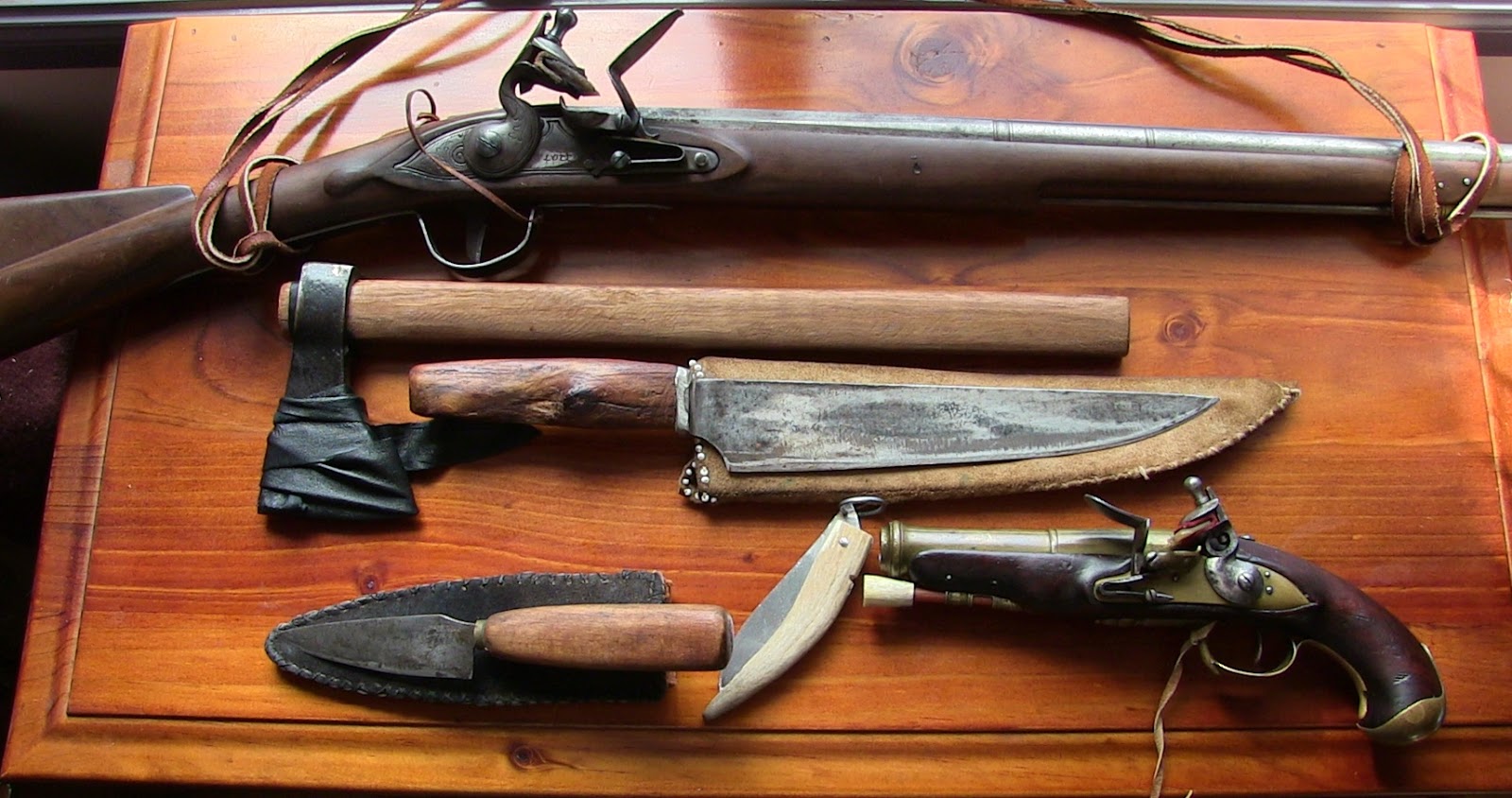
A flintlock smoothbore gun is versatile,
you can make fire with the lock without using any gunpowder, you can use
various sizes of small shot & round ball, you can if necessary use other
projectiles besides lead, you can retrieve lead from shot game & remould it
for further use. If the lock should malfunction it is easily repaired with
spare springs, if you have no spare springs the lock is easily converted to
matchlock.
·
A flintlock rifle has the same
advantages as the smoothbore except that it can not use small shot without
leading the barrel. A .32 flintlock rifle has more power than a .22 rimfire
& is less expensive to shoot.
·
You can purchase an antique flintlock
pistol now with no need for licence or registration.
·
Ball moulds can be used as heavy
tweezers for removing foreign objects from the body.
·
Gunpowder (Black Powder) can be used to
make fire with unprepared plant tinders without wasting ammunition.
·
A trade axe/tomahawk is very versatile.
The head is easily removed to be used as a hide scraper, the tomahawk can be
thrown for recreation, self defence & hunting. This axe is a good defence
weapon for hand to hand fighting, for constructing shelters & traps &
for hammering in stakes or wooden pegs. A new helve/handle is easy to make
& fit & does not require a wedge to secure the head.
·
The awl is used for making leather items
& for repairing leather items. The awl is used to make & repair
moccasins.
·
The butcher knife is for skinning &
butchering game & can be used for self-defence.
·
The legging knife is a back-up to the
butcher knife. If you should dull the edge on your butcher knife you can
continue with the legging knife. You do not want to stay around sharpening
blades. Your shot may have attracted unwanted attention.
·
The clasp knife is used for camp chores
& for making trap triggers. You do not want to use your main blades as
utility knives.
·
Flint, steel & tinderbox will enable
you to make fire anywhere in all weather conditions. It will not break or wear
out & the process is renewable & sustainable.
·
18th century woodsrunner’s
clothing (men & women) is practicle, protective, hard wearing &
renewable.
·
The housewife (sewing kit) is for making
& repairing clothing & packs. The needles can be used for removing splinters
& if needs be sewing up wounds. The beeswax is used to wax the linen sewing
thread & can be used as makeshift tooth fillings.
·
The angling tackle can be used with a
rod or set lines, it can also be used for catching ducks & large land fowl.
The linen or silk lines can be replaced with hand made cordage made from plant
materials. Silk lines can be used as suture thread.
·
The cooking kettle is used for boiling
food, boiling water for drinks & sterilising, carrying water & for
catching rainwater.
·
Cotton & linen bags can be used for
cleaning dirty water before boiling for drinking or adding to your water
bottle.
·
Gun tools are used for repairing the
lock on your flintlock muzzle-loading gun if needs be, but these locks are very
hard wearing. The tools are merely a back-up. The turn screw is used to remove
the lock & barrel for cleaning.
·
The whet stone is used to sharpen your
blades, as is the metal file, though both could have other uses if working with
metal.
·
The half-axe is optional & is
capable of heavier work than the tomahawk without adding too much weight.
·
An auger is optional & is used for
making holes for constructing more permanent dwellings. These augers come in a
variety of sizes & weigh very little. Small versions will fit in your pack,
where longer versions can be tied to your blanket roll.
·
The sword is also optional but in a hand
to hand fight can be very useful. The sword is also used for cutting reeds for
shelter & mat construction.
·
The wool blanket is far more versatile
than a sleeping bag, & if wet the blanket retains more body heat than a
sleeping bag. The pure wool blanket can be used as a matchcoat or a Great Coat
& can be used in a sitting position under an oilcloth covering on the
trail.
·
The oilcloth shelter is very versatile
& can be used in many ways, including use as a rain coat. Used as a lean-to
shelter you can use fire for warmth at night & you have good visibility on
at least three sides. The lean-to is easy & quick to construct &
quickly taken down. It does not need tent poles/rods & it is easy to carry.
Anyone using this equipment is advised
to learn the many primitive skills that go with this type of wilderness living.
If you are living this 18th century lifestyle then your level of
comfort will never drop below this level. This equipment does not wear out;
anything that could break can be repaired or replaced from natural sources. You
are also advised to carry a modern medical kit which should include an eye wash
glass.
My Equipment List.
.62 cal/20 gauge flintlock fusil. 42 inch barrel.
.70 caliber smoothbore flintlock pistol.
Gun tools and spare lock parts.
Shot pouch and contents.
Leather drawstring pouch of .60 caliber ball (in
knapsack).
Powder horn.
Ball mould and swan shot mould.
5 Gunpowder wallets
Lead ladle.
Butcher/Hunting knife.
Legging knife.
Clasp knife.
Tomahawk.
Fire bag.
Tinderbox.
Belt pouch.
Fishing tackle in brass container.
Two brass snares.
Roll of brass snare wire.
Knapsack.
Scrip.
Market Wallet.
Tin Cup.
Kettle.
Water filter bags (cotton & linen bags).
Medical pouch.
Housewife.
Piece of soap and a broken ivory comb.
Dried foods in bags.
Wooden spoon.
Compass.
Whet stone.
Small metal file.
Oilcloth.
One blanket (Monmouth cap, spare wool waistcoat and
wool shirt rolled inside blanket).
Two glass saddle flasks.
Length of hemp rope.
Bottle of rum.
Basic list of what I carry. This list is made up
from items that we know were carried, from items that my research has shown
were available, & from items that have been found, such as the brass snare
wire. I am not saying every woodsrunner carried all these items, but I am
saying that some woodsrunners may have carried all these items. From
experimental archaeology results in historical trekking, I think the items I
have chosen are a reasonable choice for any woodsrunner that is going to live
in the wilderness for a year or more.
Keith.