
Showing posts with label primitive. Show all posts
Showing posts with label primitive. Show all posts
Wednesday, February 7, 2018

Thursday, January 25, 2018
Tuesday, January 9, 2018
Petition To Have Muzzle Loading Pistols Removed From an H class licence ...
"To the Honourable the Speaker and Members of the
Legislative Assembly of New South Wales in Parliament assembled".
PARLIAMENT OF NEW SOUTH WALES.
Parliament House
6 Macquarie Street,
Sydney, NSW 2000.
6 Macquarie Street,
Sydney, NSW 2000.
The Petition of Keith H. Burgess.
President of the New England Colonial Living History Group.
President of the New England Colonial Living History Group.
Brings to the attention of the House the matter of
firearms licensing in relation to muzzle-loading pistols (percussion locks
excluded).
At this present time, working replica (replicas of
original 17th and 18th century antique muzzle-loading pistols) muzzle-loading
pistols of the lock types matchlock, wheellock, tinderlock, doglock, snaphance and flintlock can only be owned by a person
possessing a category H gun licence, and these pistols can only be legally
fired on a registered gun range. Antique muzzle-loading pistols of the same
type may be owned, but not used/fired without the owner possessing an H class
licence. This requirement excludes the use of these antiques & antique
replicas for Living History and Historical Re-enactment purposes. It also
excludes the use of these antique replicas for use as a back-up safety for
muzzle-loader hunters hunting on private property who are hunting with single
shot muzzle-loading rifles or smoothbores.
Historical Re-enactment groups and Living History
organisations have re-enactment rules which preclude the use of live ammunition
and preclude the use of a ramrod during any and all re-enactment displays. There
is also a permit requirement; this permit is for historical re-enactment
organisations wishing to conduct an historical re-enactment event involving the
possession and use of firearms by participants. Clause 61 - Firearms
Regulation 2006.
Replicas of muzzle-loading pistols of the lock types
mentioned are single shot (though some flintlocks can have two barrels), slow
to load and require a good deal of knowledge and training to ensure the
workability of this type of gun. Ignition even when used by a competent person
can not be guaranteed. Therefore these muzzle-loading guns are not suitable for
criminal use.
We fully understand the purpose of the H class licence
requirements, but these primitive muzzle-loading pistols are not the same as
modern breech-loaders, revolvers or semi-automatics. If a criminal wishes to
use a concealable gun to commit a crime, they can simply cut down a modern
breech-loading rifle or shotgun.
At present anyone can purchase an antique muzzle-loading
pistol without the need to apply for a permit to purchase, a licence or
registration. However, they cannot be legally fired/used unless the owner posesses
an H class licence. These replica muzzle-loading pistols are no different from
the antiques, their workings, capabilities & disabilities are exactly the
same.
The undersigned petitioners therefore ask the Legislative
Assembly to change the licensing requirement for these replica antique &
antique muzzle-loading pistols (percussion locks excluded) from the present
category H class licence to the category B class licence. Alternately we respectfully
request that these muzzle-loading pistols be placed on a new less restrictive
class of firearms licence , allowing these guns to be used with no more
restrictions than are presently placed on muzzle-loading long arms.
Sincerely,
Keith H. Burgess.
Petition Here:https://www.change.org/p/to-the-honourable-the-speaker-and-members-of-the-legislative-assembly-of-new-south-wales-in-parliam-muzzle-loading-pistols-to-be-placed-on-a-less-restrictive-licence/share_for_starters?just_created=true
Saturday, August 12, 2017
My Views On Carrying Modern Gadgets.

Something I posted on a UK survival forum recently after receiving so much negative feed back & comments.
Keith.
My Views On Carrying Modern Gadgets.
Okay, this is my take on the carry situation, or your Bug Out bag
contents for long term wilderness/country living.
People are for ever saying that they will rely of modern gear because it is easier to use & when it is used up or broken they will simply discard it. Many state that they carry multiple items for making fire. Maybe they do the same with other gear as well, I don't know.
Personally I have gone to a lot of research & experimentation to arrive at the best kit I can possibly carry that will last me a lifetime in the wilderness. This equipment is backed up with the skills needed to use this gear.
Now if I were to take advice from many people who advocate the carrying of modern gear & extras for insurance, then some of the items I already have in my pack would have to be taken out to (a) make room, & (b) lighten the load.
Putting it another way, when one has to discard a modern gadget, there is nothing to replace it unless you can make a primitive item to replace it. You were carrying this gadget at the expense of carrying something more suitable. You have compromised your safety & security by leaving important items out of your pack to make room for your gadgets. Does this make any sense to you?
Okay so you do know how to use a flint, steel & tinderbox & you carry one with you. You know all about plant & fungi tinders & where to find dry kindling in the pouring rain & snow. But you still want to carry a cigarette lighter, a ferocerium rod & magnesium block because? I can probably make fire faster with a tinderbox than many people can with a lighter, so why would I want to carry a lighter? I would sooner carry that extra weight & bulk in gunpowder, water, food, modern medical supplies. These items are far more important than carrying battery operated torches, magnesium blocks, ferocerium rods, cigarette lighters, plastic or tin plates, fold away solar panels, eating utensils, fuel stove, multi-tool, or the myriad of other modern gadgets that are on the market today.
A ferocerium rod is NOT a good substitute for a tinderbox. So why have one? Why are you not practicing with a real flint steel & tinderbox? If this is just a hobby for you, just a game or something you like to do when camping out, fine, I am not saying that is NOT a legitimate thing to do, but do NOT try to convince me or anyone else that this is what you should do if you seriously want to survive should it all hit the fan.
I have been doing this stuff since before it became known as prepping, I have been doing this for most of my life in all weathers. I have survived attacks from people & wild animals, I survived cyclone Tracey in 74. I have lived off grid in the bush for most of my life. I try to pass on my findings, my knowledge & my experience because I am an old man & the things that I know are rarely practiced these days. And yet I am for ever finding people getting upset by what I say & am immediately put on someone's hit list. Is it jealousy? Is it because these people were used to being top dog on the forum until I came along & upset their ratings? Or is it because I no longer live in the UK & therefore can't be considered a reliable source of information?
Yes I am out of touch with matters in the UK, I would imagine things are far worse there now than they were when I was living there. I saw my old forest & field haunts being cut down, leveled & built on. I was running out of room to "play". So I got out, came here & bought myself a forest that no one can destroy. But that does not mean that you can't take what is of use to you & discard the rest. Basic survival needs are still the same no matter where you are in the world. Even some of the plants here are the same as in the UK & other countries. Before climate change took a hold it was the same weather conditions here in New England NSW as it was in parts of the UK.
There is different equipment to suit the individual, & there is the WRONG equipment to carry. No matter how big & strong you are, no matter that you can carry a child plus your backpack, it still comes down to carrying the right gear & NOT compromising your safety. There will already be a need for some compromise when packing for a trip between two principles : minimum weight & maximum self-reliance.
Keith.
People are for ever saying that they will rely of modern gear because it is easier to use & when it is used up or broken they will simply discard it. Many state that they carry multiple items for making fire. Maybe they do the same with other gear as well, I don't know.
Personally I have gone to a lot of research & experimentation to arrive at the best kit I can possibly carry that will last me a lifetime in the wilderness. This equipment is backed up with the skills needed to use this gear.
Now if I were to take advice from many people who advocate the carrying of modern gear & extras for insurance, then some of the items I already have in my pack would have to be taken out to (a) make room, & (b) lighten the load.
Putting it another way, when one has to discard a modern gadget, there is nothing to replace it unless you can make a primitive item to replace it. You were carrying this gadget at the expense of carrying something more suitable. You have compromised your safety & security by leaving important items out of your pack to make room for your gadgets. Does this make any sense to you?
Okay so you do know how to use a flint, steel & tinderbox & you carry one with you. You know all about plant & fungi tinders & where to find dry kindling in the pouring rain & snow. But you still want to carry a cigarette lighter, a ferocerium rod & magnesium block because? I can probably make fire faster with a tinderbox than many people can with a lighter, so why would I want to carry a lighter? I would sooner carry that extra weight & bulk in gunpowder, water, food, modern medical supplies. These items are far more important than carrying battery operated torches, magnesium blocks, ferocerium rods, cigarette lighters, plastic or tin plates, fold away solar panels, eating utensils, fuel stove, multi-tool, or the myriad of other modern gadgets that are on the market today.
A ferocerium rod is NOT a good substitute for a tinderbox. So why have one? Why are you not practicing with a real flint steel & tinderbox? If this is just a hobby for you, just a game or something you like to do when camping out, fine, I am not saying that is NOT a legitimate thing to do, but do NOT try to convince me or anyone else that this is what you should do if you seriously want to survive should it all hit the fan.
I have been doing this stuff since before it became known as prepping, I have been doing this for most of my life in all weathers. I have survived attacks from people & wild animals, I survived cyclone Tracey in 74. I have lived off grid in the bush for most of my life. I try to pass on my findings, my knowledge & my experience because I am an old man & the things that I know are rarely practiced these days. And yet I am for ever finding people getting upset by what I say & am immediately put on someone's hit list. Is it jealousy? Is it because these people were used to being top dog on the forum until I came along & upset their ratings? Or is it because I no longer live in the UK & therefore can't be considered a reliable source of information?
Yes I am out of touch with matters in the UK, I would imagine things are far worse there now than they were when I was living there. I saw my old forest & field haunts being cut down, leveled & built on. I was running out of room to "play". So I got out, came here & bought myself a forest that no one can destroy. But that does not mean that you can't take what is of use to you & discard the rest. Basic survival needs are still the same no matter where you are in the world. Even some of the plants here are the same as in the UK & other countries. Before climate change took a hold it was the same weather conditions here in New England NSW as it was in parts of the UK.
There is different equipment to suit the individual, & there is the WRONG equipment to carry. No matter how big & strong you are, no matter that you can carry a child plus your backpack, it still comes down to carrying the right gear & NOT compromising your safety. There will already be a need for some compromise when packing for a trip between two principles : minimum weight & maximum self-reliance.
Keith.
Tuesday, June 27, 2017
Long Term Wilderness Living/Survival Fire lighting Methods.
Authors, historical, living history, authenticity, flint and steel, burning glass, reading glass, fire-bow, Mountain men, woodsmen, woodsrunners, books, reading, experimental archaeology, plant tinder, fungi tinder, tinderbox, fire lighting, 18th century, 17th century, 19th century, survival, Indians, primitive, fur trade, French and Indian War, Revolution, historical trekking, long term wilderness living, colonial, Australia, North America, cooking, heating, Reenacting, Reenactment, Preppers, Prepping, Survivalists, Bugging Out, Camping, Hiking, Bush Walking, Lost survival, TEOTWAWKI, SHTF, Primitive Skills, sustainable, self reliance, Off Grid, Bushcraft, Woodslore,
Primitive Fire Lighting-Flint & Steel & Fire Bow.
Title: Primitive Fire Lighting
ID: 9784776
Category: History
Description: “Primitive Fire Lighting”, is a hands on guide to how to make fire with flint and steel and fire bow. This includes some history, a variety of methods, tinder plants identification, and tinder production, tips on fire place construction and use, how to prepare and lay a fire, wet weather fire lighting and magnifying glass fire lighting. The skills and methods in this book will be of interest to a wider range of readers including survivalists, historical re-enactors, bush-walkers and campers, historical–trekkers and even historical novel writers. Although the plant identifications list is mainly Australian it also has some information for England, Europe and America.
Publisher: Keith H. Burgess
Copyright Year: © 2010
Language: English
Country: Australia
Table of Contents
Illustrations. 4
FOREWORD. 6
FLINT AND STEEL FIRE LIGHTING. 8
PLANT FIBRE TINDERS: 11
TINDER PREPARATION. 15
Tinder preparation-charring: 15
OTHER FLINT and STEEL FIRE LIGHTING METHODS: 16
Emergency methods: 17
A WORD ABOUT BLACK POWDER: 17
THE CAMPFIRE FIREPLACE: 18
READING GLASS/MAGNIFYING GLASS FIRE LIGHTING 20
WET WEATHER FIRE LIGHTING. 21
A FINAL WORD OF CAUTION. 23
FIRE-BOW FIRE LIGHTING. 24
Introduction 24
FIRE-BOW FIRE LIGHTING. 25
A Brief Overview. 25
The Parts of the Fire-bow. 26
The Bow. 26
The Drill Piece. 27
The Fireboard. 29
The Tinder-board. 30
The Bearing Block. 31
The Bowstring. 32
Tinder. 32
Making Fire. 32
Making Cordage. 37
The Step for making Cordage. 38
AFTERWORD. 40
Fire steel suppliers. 45
About the author. 45
5.83" x 8.26", saddle-stitch binding, white interior paper (60# weight), black and white interior ink, white exterior paper (100# weight), full-colour exterior ink.
Cost: Book $11.00 US. Plus P&P. Download $7.00 US

Purchase orders to: http://www.lulu.com/spotlight/KeithBurgess
Now Also Available From Barnes and Noble:
http://www.barnesandnoble.com/w/primitive-firelighting-keith-h-burgess/1113663647?ean=9781447567622
http://www.barnesandnoble.com/w/primitive-firelighting-keith-h-burgess/1113663647?ean=9781447567622
Friday, August 12, 2016
Saturday, August 6, 2016
Advantages of Prepping With an 18th Century Living History Group.

Advantages of Prepping With an 18th Century Living History
Group.
· Participating
in living history activities is fun & educational.
· Children
love living history activities & are able to share the experience with
their parents.
· Children
who participate in Historical Trekking become used to carrying their own
equipment & getting ready for the trek. IF a shtf situation should arise,
the child knows what to do to get ready to leave, no fuss & no worries.
· As
a group member you can train with the local militia which is completely legal
& does not attract unwanted attention.
· You
can learn many primitive living & survival skills including flint, steel
& tinderbox fire lighting.
· You
can use a variety of period items & learn how to make your own clothing
& equipment.
· You
can learn muzzle-loading, archery, sword fighting & tomahawk throwing.
· You
can participate in historical treks & get to actually use your equipment.
In this way you are able to choose the right equipment to suit your needs &
you will know that it all works.
· You
will learn to set up an oilcloth shelter & construct other primitive
shelters.
· Lone
wolves can still take advantage of group membership either by learning from the
group instructors, or by participating on the group’s internet forum.
This is the New England Colonial Living
History Group 1680-1760 forum address if you are interested: http://eighteenthcenturylivinghistory.freeforums.org/
Sunday, June 12, 2016
Thoughts on TEOTWAWKI

Thoughts on TEOTWAWKI
Normal survival situations in Australia are pretty easy
to prepare for. That does not mean that you will survive, we all make mistakes,
but fire, flood & drought are common in Australia & we all know what
precautions to take. I survived cyclone Tracey in 74, I was not prepared,
neither were many others in Darwin. We had so many warnings that came to
nothing, that we became apathetic. Australia's motto is "she'll be right
mate", well sh wasn't right mate in Xmas 74, & I think it would be a
big mistake to take peace & our safety for granted now.
So what are we prepping for? Well for those that have not
had their heads buried in the sand, it is pretty obvious that the threat comes
from within. From our own totally corrupt government. How far is the government
willing to go to remove all our civil & human rights? I can't answer that,
but just look at the rights we have lost already, look at the militarization of
our Police Service. Mining now takes precedent over farming & the
livelihood of Farmers. Mining takes precedent over Australia's environment.
Corrupt council rates (tax) hikes have seen people evicted from the homes they
actually own, & those homes sold by the council, & some people wonder
why so many of us WISH that the s**t would hit the fan!!!
A TEOTWAWKI is a little harder to prep for, because we
don't know what it may entail. The best we can do is assume that city life will
no longer be safe, & that our survival lies in going bush. Some like myself
& my family are already here, we are totally off grid. In the past I have
lived for about 30 years without electricity, so if our solar power should
malfunction, then it is not a problem. We have been off grid now for about 40
years. However, even though we are equipped & feel that there are enough of
us to protect what we have against raiders, there is always the possibility
that we may at some time have to leave our forest retreat. This too we are
trained & equipped for.
We do not expect there to be too much competition in
regards to hunting for food. Most so called preppers rely on modern equipment,
& others are not really prepared at all. Few will have any experience in
hunting & trapping, & fewer again will make it out of the cities alive.
I have lived in the country all my life, & I know the limitations of modern
technology. Those that start off with mostly modern survival gear will
eventually find themselves living a stone age lifestyle, IF they survive at
all! Those that depend only on pre 19th century equipment & skills will in
my opinion never drop below that level of comfort.
Keith.

Tuesday, May 17, 2016
Flint & Steel Fire Lighting-A Sustainable Method.

A selection of different fire steels & siliceous rocks.
Flint & Steel Fire Lighting-A Sustainable Method.
Flint, steel & tinderbox fire lighting is a sustainable method of
making fire. Learning about flint & steel fire lighting (NOT the Ferocerium
Rod!) will also teach you about the use of plant tinders, the types of plant
tinders in your area, & how & where to find dry kindling in wet
weather. This information is also useful in case you have to make fire with a
fire-bow. Modern fire lighting methods rarely teach you any primitive skills,
& they are not sustainable.
Plant tinders often need charring in order for them to catch a spark.
Even those tinders that do not require charring usually perform better when
charred. Plant tinders are charred directly in the fire, then they are placed
in the tinderbox & the lid closed to extinguish the embers. Once this is
done then the tinder is ready for use.
Sparks are struck from the steel using a sharp edged piece of siliceous
rock; this rock can be flint, agate, chert, quartz or whatever type is
available in your area. The easiest way to find suitable rock is to carry your
steel with you on walks & simply try any rocks you find along the way. Some
rocks perform better than others, but there are an amazing number of rocks that
will work to some degree.

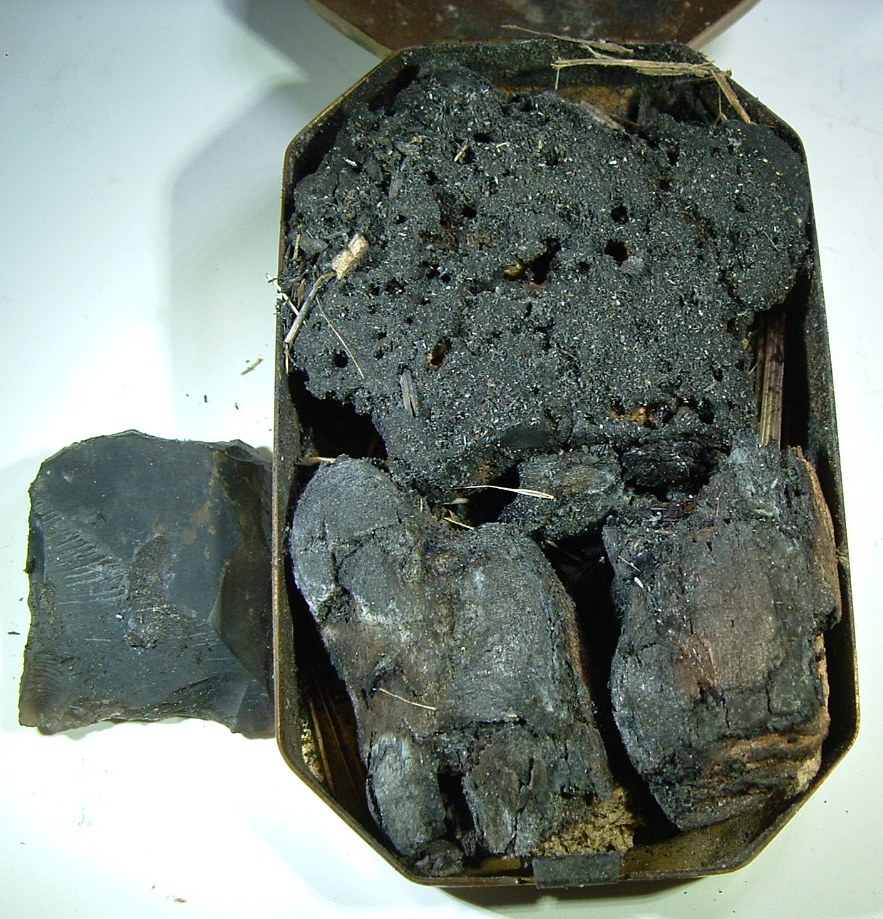
The author's tinderbox showing plant tinder contents & a musket flint.

The author's original 18th century fire steel which he secures to the buckle closure on his belt bag with a leather tie so it will not get lost.

This is a greased leather fire bag which contains the author's tinderbox. The top rolls down making it waterproof.

Spare charred plant tinder is carried in one of the author's gunpowder bags when it is empty.
Tuesday, March 29, 2016
Long Term Wilderness Living/Survival.


Long Term Wilderness Living/Survival.
After the dust has settled & the survivors have left the cities
to live in the bush, they will have to get down to some serious work in order
to continue to survive. This also applies to those of us who already live in
the bush, because our ties to the city will also be severed. Then, the
equipment we have is all we have. There will be no new supplies of anything
available to us. If the equipment we have chosen is not sustainable, then we
will be in trouble in a very short period of time.
The same can be said of the skills we have at that time. Sure we can
learn new skills, but just how much discomfort do you think you will suffer
whilst you try to learn these skills? Whether it be making fire or making your
own footwear, these skills are not learnt & certainly not mastered
overnight, & one of the problems with using modern gear is that it does not
teach you anything worthwhile.
My wife & I lived for over 20 years in the bush without
electricity or any modern gadgets. We washed our clothes by boiling them in a
copper. For light we made tallow candles & grease lamps. We grew our own
food & I hunted meat for the table with a flintlock muzzle-loading gun. We
started off this way living an 18th century lifestyle & our
level of comfort never dropped. IF we had started off using modern equipment,
we would have finished up living a Stone Age lifestyle! Yes I have the ability
to live a Stone Age lifestyle, I have the primitive skills & it is a very
secure feeling knowing this, but I do not want to have to live that way, I like
a certain level of comfort.
So my advice is, if you are really serious about being able to
survive in the future should it all go pear shaped, take a good long hard look
at the gear you have, & ask yourself “is it sustainable”? DO NOT defend
your choices of equipment to save face, DO NOT defend your choices because of its
monetary cost. We are talking about survival here, our ability to keep living,
& our quality of life. Going camping for a weekend or a month is not a good
way of reviewing your gear. It is fun, but it is nothing but just that. Fuel
stoves, matches, ferocerium rods, canned foods, torches, radios, Bowie type
survival knives, etc will not last or will not do a satisfactory job in keeping
you alive & within your comfort zone. So start learning the skills that
will keep you alive & enable you to live with a certain amount of comfort. Acquire
the tools & equipment that will support you through long term wilderness
living.
Now having said that, I would like to make it quite clear that I have
nothing against modern firearms or modern medical supplies, & I think those
life straws for purifying water sound great. BUT, if you are going to carry a
modern firearm, keep it for defence only or your limited supply of ammunition
is not going to last long if you use it for hunting as well. If you are
travelling alone I suggest you carry a bow as well, & not a compound bow.
Or if you are only going to carry one gun & no bow, get yourself a
flintlock muzzle-loading gun.
If it all hits the fan before my next post (can’t see that happening),
best of luck.
Keith.
Keith.
Saturday, February 13, 2016
If or When TSHTF Part Four. Primitive living/survival skills.
This is a basic list of skills for woodsrunners in our group. These are long term wilderness living/survival skills.


Woodsrunner’s
Skills.
This is a list
of basic skills in which I personally would expect an 18th century
woodsman or woods-woman to have some experience with in our group.
·
Flint &
steel fire lighting
·
Wet weather fire
lighting
·
Fire-bow fire
lighting
·
Flintlock fire
lighting
·
Flintlock use,
service & repair
·
Marksmanship
with either gun or bow.
·
Field dressing &
butchering game
·
Blade sharpening
·
Tomahawk
throwing
·
Making rawhide
·
Brain tanning
·
Primitive
shelter construction
·
How to stay warm
in winter with only one blanket
·
Cordage
manufacture
·
Moccasin
construction and repair
·
Sewing
·
Axe and tomahawk
helve making
·
Fishing
·
Hunting
·
Evasion
·
Tracking
·
Reading sign
·
Woods lore
·
Navigation
·
Primitive trap construction
& trapping
·
Open fire
cooking
·
Fireplace
construction
·
Clothing
manufacture
·
Drying meat
& other foods
·
Knowledge of
plant tinders & preparation
·
Knowledge of
native foods & preparation
·
Knowledge of
native plants in the area and their uses for other than tinder and food.
·
Scouting/Ranging.
·
Basic first aid.
·
Finding and
treating water.
·
General leather
work.


Friday, February 12, 2016
If or When TSHTF Part Two.

Long Term Wilderness
Living/Survival.
In a TEOTWAWKI situation, in my
opinion, the towns & especially the cities are not going to be a good place
to survive for decent people, especially those with families. My reasoning is.
1) How are you going to be able to defend yourself against gangs which are
prepared to burn you out if they can’t get you any other way? 2) Food is only
going to last a short time. The gangs will get the majority of the equipment
and food, and it will be very dangerous for anyone else out in the open on the
streets or in the stores. 3) Your ammunition for your modern firearms will not
last long if you are continually have to fight off raiders. You can of course
for a while reload your own ammo if you have the gear and have managed to
secure a store of powder, primers and lead. 4) There will be no clean water, no
electricity unless you have a generator indoors and plenty of fuel. There will
be no toilet facilities and you can not risk going outside. Yes there are
toilet systems available that do not require water, but these are not designed
to be used only in house.
So, the wise survivalist or
prepper will leave the city and move to a place in the bush, be it your own
property, or just a suitable place with running water, shelter and a food
source. If you travel early, you will be able to use some form of transport,
but if you leave it too late, the roads out may be blocked. Few people will
already be living in the bush. If you are one of the lucky ones, and you have
the money, then you will be able to set yourself up for a long term stay. But
if you have to move to your retreat when TSHTF, then again your supplies will
be limited to what you can transport.
If a survival situation big
enough to warrant leaving the city arises, many people will not know until it
is too late. Ask yourself now, what will be the signs? How will I know when to
leave? If this is the situation you find yourself in, you will have to be
prepared to ditch your vehicle if A) it breaks down, or B) the roads are
blocked and you can’t get around it. This will mean having to travel on foot.
How much of your gear and supplies can you carry on foot? What will you take
with you? What are you prepared to leave behind?
A sensible person will have
thought of this already, and what they will be packing in the vehicle will be
back-packs, and only the stuff they can carry on their backs. There may be
other separate supplies, just in case they can get through, but if they have to
walk, these separate supplies will be left behind. This preparation will take a
lot of serious thought. Remember, you are not military; there will be no
back-up supplies when you run out. You are on your own, group or individual so
choose your equipment and supplies wisely.
Something else to think about.
It is my belief that if you start
off with all modern equipment and tools, sooner or later these items are going
to start to wear out or break, and when they do, you are going to have to
resort to a very primitive lifestyle. Most of the equipment we carry is solely
for comfort and ease of living. When these items are no more, then our
lifestyle will be radically changed. If however you choose a period lifestyle
pre 19th century, then it is highly unlikely that you will ever have
to drop below this level of comfort. I chose the mid 18th century,
mainly because I am a living historian and this is my chosen period of
interest, but also because I soon came to realise that this period’s technology
is not too modern, and not too primitive. For survival purposes it gives me a
level of ease and comfort I am happy living with.
Equipment and Tools.
For every piece of equipment you
intend to take with you, ask yourself these questions: Will this add
significantly to my comfort? Do I really need it? How long will it last? How
versatile is it? Is there some better alternative? If it malfunctions or
breaks, can I fix it?
Let’s look at some typical
examples of good and poor choices. One of the most important tools you will
need is something for cutting wood. Even if you do not have to construct a
shelter, you will need to construct animal traps, some form of fencing for
gardens, possibly splints and crutches if someone is injured, maybe fishing
poles, spears, pikes, defenses, drying racks for food preservation, frames for
scraping animal skins, and possibly more besides. Saws are good but limited in
their use. A good strong pruning saw could be useful and it is not heavy, but
you will need more than this. Many people choose the machete or a similar tool.
This may be okay in a jungle, but it is still limited in its use. Only a fool
would use a good knife for cutting wood, especially if it was the only tool you
had. A knife is a very useful tool to carry but it has specific uses, and they
do not include cutting large pieces of wood.
A tomahawk on the other hand is
light, versatile and very efficient for all the tasks mentioned earlier. It can
also be thrown for recreation and hunting if needs be. The head can easily be
removed if it has a tapered eye and be used for fleshing skins. A new helve is
easier to make and fit for a tomahawk than for a modern belt axe. The poll can
be used as a hammer for driving in pegs and stakes, and it is a good fighting
tool.
Now how about your firearms? If
you only have modern firearms and no bows, then your ammunition will not last
long if you have to use them for hunting and defence. Brass shells are heavy
and you will need to carry a lot of weight in ammunition and possibly a
reloader. A modern firearm is a good idea for use in defence if you have people
to carry them, but the weight of the ammunition can make it unpractical to
carry too much ammo. There are many other important supplies to be carried by
someone. If your modern firearm malfunctions, can you repair it?
A flintlock muzzle-loading gun or
rifle on the other hand is far more versatile than a modern gun. It can be used
to create fire without using precious gunpowder; on the other hand the
gunpowder can itself be used to make fire in certain circumstances. The
flintlock is easy to repair with just a few simple tools & spare parts, and
even if you do not have any spare parts, the lock can easily be converted to a
matchlock or tinderlock for continued use. Lead is retrieved from shot game
& remoulded, so there is no need to carry a lot of lead. Also there is the
option of using other projectiles besides lead. Extra gunpowder can be carried
in place of the extra lead, which means that your supplies will last longer.
Before you go spending your hard
earned dollars on a custom knife or some Bowie look-alike, think about the use
to which your blade will be put. Your knife or knives need to be able to field
dress, skin and butcher game. They may also be needed for defence. A good
butcher knife will serve you well in this regard, which is why the butcher
knife was the most commonly carried knife by woodsmen and Indians alike back in
the 18th century. A legging knife can be carried as a back-up to
your hunting knife, and a good clasp knife will serve well for camp chores and
making pot hooks and trap triggers. All three of these knives can be purchased
for the cost of a modern camp or hunting knife.
Saturday, October 31, 2015
TEOTWAWKI Australia. Practicle Primitive Survival. Part One.
This series of articles will mainly focus on pre 19th century equipment & methods, but may include some modern gear where practicle.

1) Where best to start. Probably the best place to start is getting things clear in our minds about what we intend to do if life as we know it now changes. If the economy falls into a depression, then we will all probably be staying at home IF we can still afford to pay the rent. Home owners will still be expected to pay the local council tax/rates. IF you can’t afford to pay rent or rates, then you will have to find somewhere else to live. Hopefully, as illegal as the local council is in assuming it is in fact a local government, it will see fit to lower the cost of the tax/rates or cancel them all together until the depression is over. Either way, there will be a lot of people out of work, & these people need to have shelter, food & water. These things may still be available in the cities & towns, but these areas will increasingly become more dangerous to live in the longer the depression lasts, so we can now add a fourth need, safety.
Keep these priorities in mind when looking for a place to settle in the bush. Water will be the most important; water will provide game & other foods. Look for a place where Cumbungi grows if possible.
Keeping the above in mind, we will continue with material needs. If you are to leave the city or town, or if you have to hunt & forage, you will need some form of backpack. This can be a simple sack with rope straps tied to the lower corners & gathered around the top, to an inexpensive knapsack purchased at an op-shop. There are plenty of alternatives. I have made several different types of carriers from converted haversacks to 18th century market wallets & snapsacks.

This is what the French call a Havresac Double. It is similar to the pack known as a Rucksack, & is also much the same as the simple sack method I mentioned above with the straps attached to the lower corners & the gathered top. If you have the time & a sewing kit, you can sew cloth straps top & bottom instead of having to attach the straps at the top to the gathered neck. Now you may be thinking that this knowledge is of little use to you because you already have a good back pack, but remember, every member of your family or group may need to have a back pack each, & it is also possible that you may lose the one you have in some incident along the trail.


 This is a knapsack I made from converting an inexpensive “made in China” old school haversack. These come in a couple of different sizes.
 Here is the smaller version of the above with blanket roll & oil cloth secured to the carry straps.

Here is my own personal knapsack which is also a converted haversack that my wife made for me many years ago. I found that as a haversack it simply did not perform well on the trail carrying more than any haversack was intended to carry, so I cut the carry strap & added more length to turn it into a knapsack. This one also has a chest strap attached. As you can see my oil cloth is secured under the flap closure, & my blanket roll & spare moccasins are tied to the carry straps. Try & avoid zippers on packs, they are usually the first thing to break. If you have buttons, keep them handy so you can repair these packs when the zippers malfunction.


Cumbungi.
1) Where best to start. Probably the best place to start is getting things clear in our minds about what we intend to do if life as we know it now changes. If the economy falls into a depression, then we will all probably be staying at home IF we can still afford to pay the rent. Home owners will still be expected to pay the local council tax/rates. IF you can’t afford to pay rent or rates, then you will have to find somewhere else to live. Hopefully, as illegal as the local council is in assuming it is in fact a local government, it will see fit to lower the cost of the tax/rates or cancel them all together until the depression is over. Either way, there will be a lot of people out of work, & these people need to have shelter, food & water. These things may still be available in the cities & towns, but these areas will increasingly become more dangerous to live in the longer the depression lasts, so we can now add a fourth need, safety.
Keep these priorities in mind when looking for a place to settle in the bush. Water will be the most important; water will provide game & other foods. Look for a place where Cumbungi grows if possible.
Keeping the above in mind, we will continue with material needs. If you are to leave the city or town, or if you have to hunt & forage, you will need some form of backpack. This can be a simple sack with rope straps tied to the lower corners & gathered around the top, to an inexpensive knapsack purchased at an op-shop. There are plenty of alternatives. I have made several different types of carriers from converted haversacks to 18th century market wallets & snapsacks.

Image from Diderot.
This is what the French call a Havresac Double. It is similar to the pack known as a Rucksack, & is also much the same as the simple sack method I mentioned above with the straps attached to the lower corners & the gathered top. If you have the time & a sewing kit, you can sew cloth straps top & bottom instead of having to attach the straps at the top to the gathered neck. Now you may be thinking that this knowledge is of little use to you because you already have a good back pack, but remember, every member of your family or group may need to have a back pack each, & it is also possible that you may lose the one you have in some incident along the trail.


Here is my own personal knapsack which is also a converted haversack that my wife made for me many years ago. I found that as a haversack it simply did not perform well on the trail carrying more than any haversack was intended to carry, so I cut the carry strap & added more length to turn it into a knapsack. This one also has a chest strap attached. As you can see my oil cloth is secured under the flap closure, & my blanket roll & spare moccasins are tied to the carry straps. Try & avoid zippers on packs, they are usually the first thing to break. If you have buttons, keep them handy so you can repair these packs when the zippers malfunction.

The Snapsack. This one is made from lined. One strap, carried on the back or by your side. The opening can be tied closed.

The Market Wallet. No straps, can be carried over the arm or shoulder. I use mine secured under the flap closure of my knapsack to carry extra light goods.

My haversack, made from a piece of old stockman's coat. Good for foraging or carrying water bottles or food.
Saturday, February 14, 2015

Subscribe to:
Posts (Atom)