(Foreword: This
article is not supposed to be a blow for blow account of what I think you
should carry, it is simply an article to make you think seriously about what it
is you are trying to prepare for. To make you think about the items that you
may NEED, rather than the items you would LIKE to carry but are not really necessary. If you seriously think that I am wrong, and you think that what you are doing is right, then there is no argument from me, each to their own. This is my personal perspective of the fraternity in general, having read many forums, Australian English and American).
Only A Matter Of Time, By Robert Griffing.
Are You Really Serious About Surviving TEOTWAWKI ?
I ask this question
because no matter how much I write, no matter how many questions I answer,
people keep coming back with the same questions. So called preppers and
survivalists , at least the majority of them, are more interested in modern
gadgetry, modern firearms, freeze dried foods, military webbing and camo
clothing than they are about actual survival. If TEOTWAWKI actually happens,
for the average household, the average family, couples and singles, this is not
going to be a walk in the park, nor is it going to be a military exercise where
there will be frequent supply drops of food and ammunition.
You will be on your
own ; No more food supplies, no more modern ammunition, no more medical
supplies, no more batteries. Some say well I have a solar charger and it does
not weigh much and takes up hardly any room. Well fine, but what do you need
the batteries for? A radio? A torch? Are they really that important to you? You
are having to “Bug-Out” into an unknown wilderness where food and water may be
in short supply, and you think that a radio and a torch are important items to
carry to help in your survival?
If you want to join a
survival/prepping forum so you can talk about your favourite interest, fine,
but don’t kid yourself that all that gear you are showing everyone is going to
save your life. Your clothes will wear out, your footwear will wear out. If you
use a modern firearm for hunting and self-defence, your ammo will run out. That
Rambo knife you purchased will eventually break if you keep battening it to
split wood, and when you try to skin and butcher game, you may find it is
blunt. Do you have a back-up blade? Is it any better suited to the task in hand
than the survival Rambo knife?
When packing your
Bug-out bag or knapsack or whatever, you will have to compromise between two
principles, minimum weight, and maximum self-reliance. I will say that again so
you fully understand it’s importance; MINIMUM WEIGHT, and MAXIMUM SELF-RELIANCE.
Do you know what you will be looking for in your new home? Do you know what
tools you will need to make your shelter, gardens, toilet area, drying racks
for clothes and meat?
Have you ever been in
this situation before? You will have to sleep light, listening for any unusual
sounds. A radio playing will mask those sounds and may cost you your life, or
someone else’s life. Shining a torch around at night could bring unwelcome company, get used to seeing in the dark. What are you going to use your
multi-tool for? Think about it. All that you need are some very basic tools IF
you are serious about survival. Don’t carry items that are likely to breakdown
and can not be repaired. A bow is a good hunting tool, but you don’t need a
compound bow that requires special arrows and a special string.
Woodsmen and
woods-women survived in the 18th century wilderness long term, and
generations did this for hundreds of years. Think about that. What did they
carry? A flintlock gun, a good hunting/butcher knife, maybe a legging knife for
a back-up, and a clasp knife for camp chores and making traps. A tomahawk did
the heavier cutting work when making shelters, and it was/is a good tool for
self-defence. Learn how to throw your tomahawk and it also becomes a tool for
recreation, and hunting if needs be. A few simple tools and spare parts will
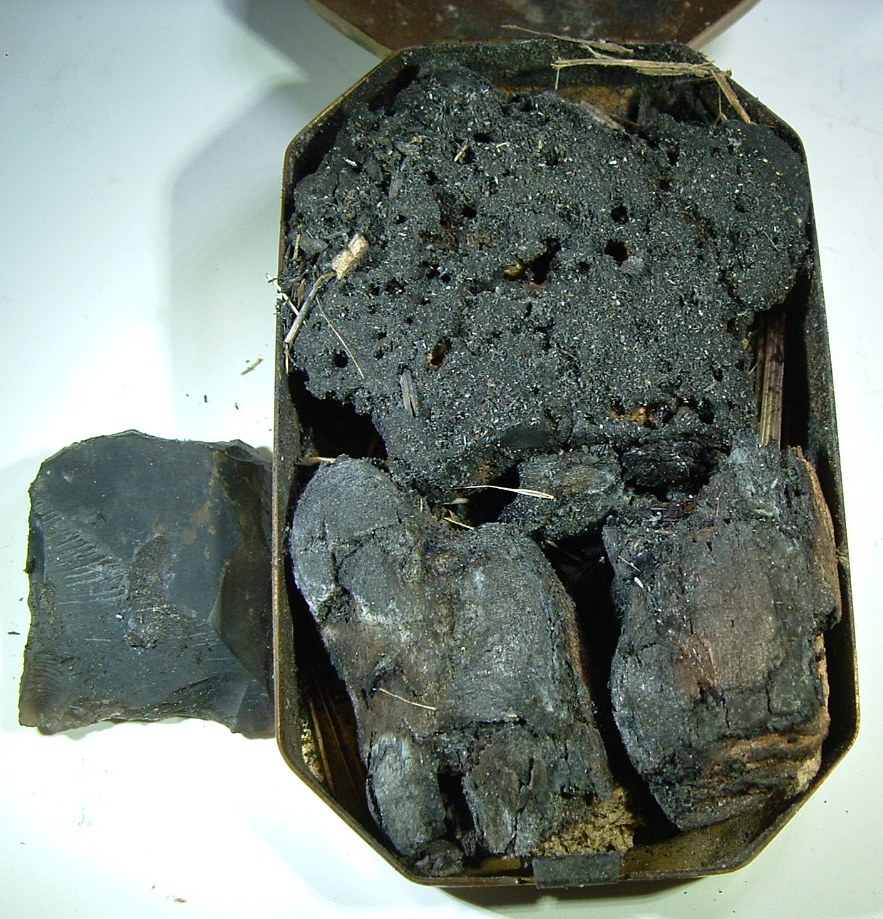
keep your flintlock serviceable for a life time. Flint, steel and tinderbox are
also reliable methods of renewable fire lighting in all weather conditions.
I am not saying don’t
take a modern firearm, I am saying don’t take a modern firearm at the expense
of carrying a better hunting tool. If you have a partner that can afford to
carry a modern firearm and ammo, fine. It will make a good tool for
self-defence. Take a good modern medical kit too, and remember to carry plenty
of vitamins and any personal medications. Think about what will be most useful
to you in a long term wilderness situation. Gun or bow, ammunition, gun tools, water,
food, flint and steel, knives, tomahawk, moccasins that you can make yourself,
the knowledge to tan hides and make simple clothing items, clothing with no
stress points that will last a long time, fishing tackle, a kettle for cooking
food and sterilizing water, rope for trail snares, brass picture wire for small
game snares, copper wire for gun repairs, a wooden spoon for cooking and
eating, soap, hair comb, sewing kit, water filtration bags, a solar still, a
canvas for shelter, a good wool blanket, extra clothing for cold nights,
gunpowder, lead, ball and shot moulds, lead ladle. Is there anything here that
you are prepared to sacrifice for the sake of carrying some modern gadget that
is not renewable, that is not really NEEDED?
If I should find that
I still have room to carry more, and I can handle the weight, I can think of
far more important things to carry than a multi-tool or radio or torch or any
number of fancy gadgets. I would be carrying more water, more dried foods, more
gunpowder and more lead. IF you are serious about survival, don’t waste this
opportunity to choose the right gear for the job in hand. If you are making a
b.o.b for your teenager, explain to them why it is important that they carry
more food instead of that radio or their mobile phone. Walking along a trail
with ear phones blaring music is a sure way to get yourself killed, you won’t
hear the warning, you won’t hear what’s coming, use your head.
Now spread out all the
gear you have, and give it an honest appraisal. Do you NEED it? Will it help save
your life? Is there anything that you should be carrying more of instead of
that item? Anyone can make excuses for carrying certain items that are not
really needed, but the fact is that they all add up. They all take up room and
together they add weight. How many early pioneers finished up ditching furniture,
clocks and luggage trunks along the trail? Many of them. Because the trail was
long, and at every mile the weight seemed to increase for the horses carrying
or pulling this load, it increased for every person carrying too much on their
backs. This survival scenario is serious stuff. If you genuinely believe, that
in your lifetime TEOTWAWKI situation may arise, then get serious, ditch the
rubbish now, don’t wait for the trail so you can leave items behind to help
other people follow your trail.
DO NOT assume that you
will be driving your vehicle all the way to your destination, you can’t
possible know or guarantee this. You may have to ditch your vehicle along the
way to your retreat, and if you were to drive your vehicle all the way into the
virgin bush, you will be leaving a trail for unwanted company to follow all the
way to your hideout. Only take what you can carry on your backs. It may have to
be heavy, you may have to take frequent rest stops even if you have kept everything
not needed out of your pack.
If you are in company,
in a group, then think about what people can carry. Lead scouts need to be able
to defend themselves and the group, same with the rear guard and the flankers.
Some may need to carry a few personal items, such as a knife, a bow, and a
tomahawk. Other than that they will be carrying; food supplies, medical
supplies, gunpowder, lead, water. If you are carrying a muzzle-loading gun,
then less lead is needed, and you can carry more gunpowder instead. Make sure
you have a good mix of archers, muzzleloaders and modern firearms in your
group. The bows and muzzle-loading guns are mainly for hunting and back-up
defence if required. The modern firearms are purely for defence, nothing else,
and long term they are not to be relied upon. You simply can not carry enough
ammo for a modern firearm, and you can’t afford the weight of reloaders, nor
can you rely on the continued good condition of primers.
So which is it to be,
an activity that you enjoy doing but are not seriously expecting to have to
face TEOTWAWKI in your lifetime, or if you believe that a SHTF situation could arise
for real, are you going to get serious about your survival and the survival of
your family?
Keith.




.jpg)


