Showing posts with label rifles. Show all posts

Tuesday, October 17, 2017

The Flintlock Muzzle-Loader Versus the Modern Breach-Loader for long term wilderness living.


The Flintlock Muzzle-Loader Versus the Modern Breach-Loader for long term wilderness living.

The advantages of the breach-loader.


1) The breach-loader is easy to load, & repeaters are fast to reload.
2) Some rifles are accurate over a long distance.
3) The shotgun is fairly versatile but a short distance gun only.
4) The .22 rimfire rifle ammunition is light in comparison to larger calibers so you can carry a reasonable amount of ammo.
The disadvantages of the breach-loader.
The larger calibers use heavy ammunition, that is the weight of the brass shells combined with the lead is heavy. The 12 gauge shotgun ammunition is very heavy, so in both these cases you may be limited as to how much ammo you can carry with you. You could reload your own shells using the smaller & lighter hand loader, but you will still have to carry spare primers & possibly lead as well.
The .22 rimfire has its limitations when it comes to what game you can kill with it. Small to medium game should not be a problem with well placed shots, but the .22 rimfire does not have the power to consistently shoot larger game, i.e. larger game is more likely to get away wounded.
Advantages of a Flintlock Muzzle-loader.

1)      Ammo is less expensive than a modern equivalent calibre firearm.
2)    The smoothbore is very versatile, being able to digest round ball, bird shot, & buckshot, or any combination of two of these (can also use minies/conical slugs).
3)    The fusil is lighter to carry than a modern equivalent sized gun.
4)   You can vary the load if needs be.
5)    The smoothbore will digest other projectiles besides lead.
6)   Lead can be retrieved from downed game & remoulded with a simple mould & lead ladle. This means that you can carry less lead, & more of the lighter gunpowder.
7)    You can make your own gunpowder.
8)    You can use the lock to make fire without using gunpowder.
9)   You can use gunpowder for gunpowder tinder fire lighting if needs be.
10) IF the lock should malfunction (these are very robust & it is not likely) you can easily repair it if you are carrying a few spare springs & a few simple tools.
11)   If you do not have any spare parts & the lock malfunctions, you can easily convert it to a tinderlock or matchlock & continue using it.
12) You do not need a reloader, brass shells, caps, or primers. The latter have been known to break down in damp conditions or if they are stored for too long.
13)  Wadding for ball or shot is available from natural plant materials or homemade leather or rawhide.
14)Less chance of being affected by future ammunition control legislation.
15) Gunpowder is easily obtainable providing you have a muzzle-loader registered in your name regardless of calibre (NSW).
16) A .32 calibre flintlock rifle is more powerful than a .22 rimfire, less expensive to feed, more accurate over a greater distance, able to take small & medium sized game, & other than not being able to use shot (unless it is smoothbore), it has all the attributes of the other flintlocks. For larger game you can load with conical slugs, which of course you can make yourself in the field.
17) Damage from a .62 calibre or .70 calibre pistol or long arm is in the extreme. Wounded prey is unlikely to escape.
18)  By using buck & ball you are unlikely to miss your target. This load is capable of taking out more than one target.
19) There is less kick-back to a muzzle-loading gun.
20)            Antique Flintlock muzzle-loading guns do not require a license, registration, or a permit to purchase in NSW Australia.
The disadvantages of a flintlock muzzle-loader.
The muzzle-loading rifle is slower to load than a single shot breach-loader. Smoothbores are a little faster to load if you are using cartridges, but they are still slower to load than a modern breach-loader.
It takes skill & knowledge to get the best performance from a flintlock, but once learnt you should have no problems.
Gun flints need knapping from time to time to keep them sharp.
You can get misfires on occasions if you fail to keep the gun flint sharp, or if the gun flint should become loose in the jaws of the cock.

If anyone can add to this article I welcome your input.
Keith.


Monday, September 25, 2017

Centerfire versus Muzzle-Loader.

Centerfire versus Muzzle-Loader.
In a fire fight no one can deny that it would be better to have a modern cartridge gun than a muzzle-loading gun, but let’s just look at some pros & cons for something to think about.

Post shtf modern ammunition will no longer be available. Modern ammunition is heavy. You may prefer to carry a 9mm Glock or a 357 magnum, but for most people this will mean having to join a pistol club, paying club fees plus the cost of the handgun & the constant purchase of ammunition, because you have to attend regular shoots to retain your membership & your “H” class licence. If you plan on using this handgun post shtf, then you will need to stock up on ammunition, or at least get as much as restrictions will allow. If you are planning on “Bugging In”, then you can get some reloading equipment. It may not be practical though to carry this reloading equipment with you if you have to leave home. It all depends on how heavy & bulky it is & you do not want to compromise your survival by not carrying enough water, food & ready made ammunition. Don’t forget that if you are planning on reloading your own ammo, you will need primers, possibly more brass, smokeless gunpowder & of course lead.

A flintlock pistol only requires gun flints, gunpowder, wads or wadding & lead. Any siliceous rock will work in a flint lock. Black powder, wads & wadding you can make yourself, & lead is easy to come by & you can mould your own ammunition. You can also make paper cartridges for faster reloading if you have a smoothbore. A smoothbore pistol can fire shot & round ball, either or both together.
You do not need a licence, registration or a permit to purchase in NSW (check your own state legislation) if you are buying an antique. You don’t need to carry a lot of lead, as you will only be using this pistol for defence. If you have the stomach for it you can retrieve spend lead from a dead foe or game & remould it. No heavy reloading equipment is required, just a ball mould & a small lead ladle. Gunpowder is light in comparison to lead, so you can carry enough to last you a very long time. If you were to run out of lead, you can substitute other projectiles obtained from nature.


Tuesday, September 12, 2017

Reclassification Of Firearms In Australia!


One of our legal minds has been looking at the ‘appearance’ provisions of the Victorian Firearms Act 1996.
The offending provisions are found in sections 3A and 3B of the Act which give the Chief Commissioner broad powers to either temporarily or permanently recategorise Cat A or B firearms on the basis of appearance. 
In fact, if you read what he has to say carefully, you’ll see it’s worse than that. The Chief Commissioner can recategorise firearms for reasons which go beyond appearance – or for no reason at all.
In his words, sections 3A and 3B are ‘really good examples’ of delegated legislative authority gone wrong, and their continued operation presents issues surrounding natural justice and procedural fairness for licence holders.  Here are some key points regarding their operation:
Section 3A
Section 3A provides the Chief Commissioner the power to temporarily declare a firearm to be Category D or E for a period not exceeding 12 months. There is no necessary link to a firearm’s appearance, operation or other characteristics.
The only criteria for a temporary declaration is that it be validly declared by the Chief Commissioner in an instrument.  The Act provides no clarification of what type of ‘instrument’ is required or its form; however, in practice the declarations have been published in the Victorian Government Gazette in a specific format.
The Chief Commissioner does not need the Minister’s express approval to exercise this power; however, it must be exercised in ‘consultation’ with the Minister.
The Chief Commissioner has a positive obligation to publish the declaration ‘as soon as practicable after the declaration is made’; however, the declaration is in effect immediately—prior to publication, and prior to the public being able to see how the law has changed.
Section 3A(3) states the declaration remains in place unless revoked by the Chief Commissioner or their expiration at 12 months. Neither in the Act nor in the second reading speech for the Firearms Amendment Act 2007 (VIC) (which inserted s 3A) is the process for parliamentary scrutiny of a declaration under s 3A outlined. The takeaway is the Chief Commissioner’s power is not expressly limited by either the Act or the Minister and it should be.
Section 3A(6) gives the Chief Commissioner powers to use his declaration to override regulations made by the Minister under the powers conferred at s 191 of the Act. This is remarkable because it means an unelected statutory officer has the power to override a Minister accountable to the Victorian Parliament, even if the Minister drafted regulations permitting a specific type of firearm affected by the Chief Commissioner’s declaration. This is an area that could be explored and challenged.
The defence provided by s 3A(7) is a defence rather than a bar on prosecution. In practical terms this means police may (unwisely) charge a person with an offence and use the process as punishment.
Finally, the administrative review options available to affected shooters are very narrow. The Chief Commissioner’s decision would be difficult to challenge in a merits based review as his power is broad and can be arbitrarily exercised against any type of firearm without the requirement for further justification. As long as the procedure is followed there is little that can be viably challenged in either a tribunal or court.
Section 3B
Section 3B is a good example of where the police have pursued a long term goal in terms of restricting access to firearms for Victorian shooters.
Section 3A was inserted into the Act in 2007, only for Victoria Police to seek out permanent powers with s 3B in 2008. Section 3B differs from s 3A in its permanency, technicality, and the legal restrictions placed on the Chief Commissioner when making a declaration.
Section 3B gives the Chief Commissioner the power to permanently recategorise firearms if he is ‘satisfied’ it is ‘designed or adapted for military purposes, or substantially duplicates a firearm of that type in design, function and appearance’.
‘Satisfied’ opens the Chief Commissioner’s decision up to review in a way s 3A lacks. It gives him a positive duty to consider information and his decision. ‘Designed or adapted for military purposes’ is the key term and it has not yet been satisfactorily clarified by a court. The latter terms ‘substantially duplicates’ and ‘design, function and appearance’ hinge on the earlier ‘military purposes’ definition.
Section 3B(1) is really an just an appearance based law that has technical issues from a drafting perspective but gives the police the powers they want—to permanently recategorise any firearm they do not want Victorian shooters to access.
In terms of its operation, the Firearms Act 1996 (Vic) is structured on the objective criteria of a firearm’s characteristics based on its calibre, cyclical operation, or ammunition capacity. A firearm is categorised based on whether it is rimfire or centrefire, bolt action or semi-automatic, or holds a particular number of rounds, etc. This is the basis for ‘categories’ of firearms and the licences that permit shooters to hold and use such firearms.
Section 3B(1), however, provides the Chief Commissioner the power to alter the law via delegated legislative authority using the ‘military purposes’ basis and a declaration. This ‘military purposes’ basis is at face value objective: an exhaustive list of firearms ‘military firearms’ could theoretically be produced. However, the terms ‘designed or adapted for military purposes’, ‘substantially duplicates’ and ‘design, function and appearance’ create a subjective test based on whether the Chief Commissioner is ‘satisfied’ a firearm can fall into this category. There is no necessary link to its calibre, cyclical operation or even appearance.
The Chief Commissioner has a duty to choose which category ‘most closely resembles’ the applicable firearm when recategorising through declarations. This does not mean the category need be appropriate, only the closest.
Section 3B does not have the same issue with ex post facto laws as s 3A. A declaration only comes into effect the day it is published or at a latter point listed in the declaration. This removes some of the compliance difficulties for those holding the applicable firearm.
Appealing a decision to reclassify
The criteria listed above provide an affected shooter the ability to challenge the Chief Commissioner’s decision and declaration under s 3B through administrative review in a way that s 3A lacks. The exercise of power under s 3B is vulnerable if the Chief Commissioner doesn’t arrive at a decision with a process and records of that process. In light of the recent examples of Victoria Police’s response to requests for information surrounding their decisions (including the ongoing CFCV VCAT proceedings), an affected party could face a substantial challenge in obtaining the relevant documents.
If an affected party challenged a declaration under s 3B and sought specific guidance from a court or tribunal on the interpretation of ‘designed or adapted for military purposes’, ‘substantially duplicates’ and ‘design, function and appearance’, the Chief Commissioner’s powers would probably be narrowed, but not to the extent it would deprived him of broad power to recategorise firearms under s 3B.
The Chief Commissioner would almost certainly retain the power to recategorise both milsurp rifles (including antique examples) and the range of new sporting rifles produced with picatinny rails, pistol grips or other features disliked by some.
A law which is bad in principle
Licencing laws based on subjective criteria are bad in principle and worse in operation. They lack the certainty required for shooters to know the boundaries of the law lay, and in this example provide Victoria Police with inappropriate powers.
Section 3B is so broad in its application it may permanently capture almost any firearm available in Victoria. From fighter pilots using shotguns to shoot clays to understand leading targets, to bolt action 22s being used by others for survival training, the Chief Commissioner can call upon obscure examples of military use to enliven his power.
To date the Chief Commissioner has refrained from recategorising, for example, Snider-Enfield .577 rifles as Category E firearms; however, this only indicates that Victoria Police have focussed on the appearance of firearms as justification for use of these powers.
They should be repealed
For Victorian shooters if the issues regarding the operation of sections 3A and 3B are narrowed, it’s about two things.
First, s 3A gives the Chief Commissioner power that in practice can be exercised arbitrarily and with little opportunity for legal review or democratic scrutiny.
Section 3A should be repealed outright.
Secondly, s 3B is centred on the Chief Commissioner’s use of an unreasonably broad criteria that is subjectively interpreted and applied. Unlike the Firearms Act 1996, this power stands in contrast to the objective criteria of categorising a firearm’s characteristics based on its calibre, cyclical operation, or ammunition capacity.
It too should be repealed.
If a power is necessary to recategorise particular firearms then it should only be conferred upon the Minister and subject to parliamentary scrutiny or disallowance.
Most Victorian shooters will agree that appearance or other subjective criteria should not be used to de facto ban firearms that are otherwise identical to those available under Category A and Category B.


Wednesday, March 15, 2017

States agree on gun control code. AUSTRALIA.


States agree on gun control code
Author: ANDREW DARBY, GERARD RYLE
Date: 26/05/1995
Words: 590


Publication: The Age
Page: 3
Hobart.
The states took a tentative step towards uniform gun laws yesterday when police ministers agreed to establish a national gun-control code on shooter licensing, mail-order sale, safety training and secure storage.
The Federal Government will also further restrict the importation of ammunition and machine pistols. But those attending the Australian Police Ministers Council yesterday left unresolved a national argument on the registration of all guns.
The federal Justice Minister, Mr Kerr, described yesterday's code decision as ``a step towards uniformity".
He said quick responses to shooting tragedies in different states in recent years had led to ad hoc, potentially conflicting standards. Now ministers had set up a mechanism to take a more considered, long-term view.
Mr Kerr said the latest statistics showed that in 1993, only about 70 of Australia's 526 firearm deaths involved violent crime.
The planned code was welcomed by Victoria's Police Minister, Mr McNamara, as the most significant improvement in decades, and one that would remedy Victorian concerns about the effect of more relaxed laws in other states.
``It's the hoons and lunatics that everyone wants to see firearms removed from," he said. ``We need to look at measures where we can more closely interact with mental health authorities so that we can identify persons who should be prohibited from obtaining firearms."
The NSW Police Minister, Mr Paul Whelan, did not attend the meeting and is awaiting a briefing. Mr Kerr was confident that NSW and the other absent states, Queensland and the Northern Territory, would agree with the proposals.
While all jurisdictions now follow the principle that firearms be securely stored, the provision was variously interpreted. A Western Australian model is being proposed in which guns must be kept in steel cabinets with separate lockable ammunition storage.
The Victorian Justice Department is to coordinate the development of the code, which will be put before the next Police Ministers' Council meeting in Tasmania in November.
The Commonwealth's tightening of imports will outlaw a variety of ammunition, including military ammunition greater than 12.7mm, tracer bullets, armour-piercing and flechette ammunition.
Imports of standard hollow-point and soft-nosed ammunition will still be allowed, but a prohibition on military-style weapons will be extended to pistols configured as semi-automatic machineguns.
The president of the Sporting Shooters Association of Australia, Mr Ted Drane, said there were up to four million licensed shooters who ought to be consulted before changes were made to gun laws.
``We will never have national gun registration because that would mean that too many people (politicians) would lose their seats if they did in places like Queensland, New South Wales and Tasmania," he said.
A spokesman said Victoria's chief commissioner of police, Mr Neil Comrie, said he supported uniform gun laws.
THE PROPOSED GUN CONTROL CODE.
Recognition of licensing, perhaps with a categorisation system.
Control of mail order firearm sales.
Firearm safety training standards.
Pistol registration methods.
Secure storage standards.
Regulations governing types of ammunition are to be tightened.

Thursday, October 20, 2016

What Skills Will Allow You To Do & Not Do.

Medical Kit.

Medications.

Food bags & containers.

Water bottles or flasks.

Tools for hunting & defence.

Shelter & bedding.


What Skills Will Allow You To Do & Not Do.
The debate regarding equipment versus skills is ongoing, in my personal opinion, both are of equal importance. We are not just talking about survival; we must also be concerned with our quality of life. Yes learning primitive skills for long term survival are very important, but you have to think about what these skills can provide you with & what they can’t. For instance, if you need to cook a stew, then you need a fireproof container. You could experiment making clay vessels, you can also use animal skins & use the hot rock method. But how much easier is it to carry a metal kettle with you?
So why am I mentioning this? I am mentioning this because weight matters if you have to carry it on your back when travelling on foot. There has to be some compromise between two principles, minimum weight & maximum self-reliance. When people are asked about the hunting tools/weapons, top of the list is usually high powered breech-loading firearms. These are fine for self-defence, but how practicle are they for long term survival? The larger the caliber, the more the ammunition weighs, & the more space in your pack it takes up. We need to prioritise, is it more important to carry a lot of weight in modern ammunition? Or is it more important to carry more medical equipment & supplies, vitamin supplements, more food & more water? If we are travelling alone, we can not carry both.
If we are only carrying a modern firearm & we intend to use it for hunting & defence, then the ammunition will not last long. We can of course avoid a fire fight by keeping a low profile, & we can save on ammunition by setting up a trap line for meat. But how secure will you feel knowing that when your ammunition runs out, you will be left with nothing with which to defend yourself or procure game? Your alternatives are: carrying an air rifle, carrying a traditional bow & arrows, or carrying a flintlock muzzle-loading gun/rifle & pistol. Another alternative for those in America might be to carry a modern sidearm in combination with one of the aforementioned hunting tools, or carry a bow & a modern firearm.

Weight is the all important factor, that & sustainability. Solid form medications have a long shelf life, so we need to take advantage of this. Dry foods too have a long storage capability & it is important that we carry as much food as we can. Eventually we hope to be able to take the time to forage for edible flora & hunt & trap game, but until that time comes, we are on the move & we need to keep a low profile.
Can primitive skills supply you with medications? Yes of course they can, but finding the herbs you need will not be easy, & especially so if you are already feeling ill. We need to think about our well being, our comfort. Any item that is sustainable & will make life easier is worth carrying, within reason. Skills will enable you to make a survival bow & arrows, but if you should ever come up against someone with a gun, you may have some difficulty surviving. Something that people often fail to take into account is the shock factor of a firearm, the noise & the impact of the missile. A bow against a firearm can not deliver this.
Anyway, the purpose of this article is to make you think before you leap. Think about the equipment you are going to carry & how it will best benefit your survival physically & mentally. Learn all you can about primitive skills, & if you plan to survive on your own retreat, then think about the living skills you will need to keep things in good repair.
When it comes to transporting equipment on foot, you can use a hiking trolley, but like all forms of transport from vehicles to animals, there will always be a negative side. The tracks you will leave to be followed, the places you can’t go, the noise you will make.


Saturday, February 13, 2016

If or When TSHTF Part Five. My choice of the best gun for long term wilderness living. The Muzzle-Loader.

Any muzzle-loader will give you an edge in long term wilderness living except the percussion lock. The percussion lock, also known as a caplock, requires fulminate of mercury caps for its ignition. This method is NOT sustainable. Tinderlocks & Matchlocks are good but they require a burning fuse at all times making you visible in the dark & the gun not so pleasurable to use as other later locks. The wheellock is good but does require Pyrite for its ignition & this is not always easy to find.

The flintlock requires a siliceous or igneous rock for ignition & this type of rock can be found in the bush if you know what you are looking for. I find the easiest way is to carry a fire steel with you & simply test the rocks you come across to see if they are hard enough to create sparks by striking the steel.

Above: This is English flint, a siliceous rock which can occasionally be found in coastal areas of Australia where English ships dumped their flint rock ballast before taking on a new cargo.


Above: This is agate which can be very common in places in Australia. Agate was used a lot in place of flint for flint & steel fire lighting. Agate is also a siliceous rock.


Above: This is quartz, very common in places & although it tends to fracture easily it is still a good rock to use for gun or fire lighting.

Above: Green chert.
http://www.aradon.com.au/green_chert.html;

Jasper.


This is obsidian, an igneous rock or volcanic rock.

Advantages of A Flintlock Muzzle-loader.
1)    Ammo is less expensive than a modern equivalent caliber firearm.
2)    The smoothbore is very versatile, being able to digest round ball, bird shot, & buckshot, or any combination of two of these (can also use minies).
3)    The fusil is lighter to carry than a modern equivalent sized gun.
4)    You can vary the load if needs be.
5)    The smoothbore will digest other projectiles besides lead.
6)    Lead can be retrieved from downed game & remoulded with a simple mould & lead ladle. This means that you can carry less lead, & more of the lighter gunpowder.
7)    You can make your own gunpowder.
8)    You can use the lock to make fire without the need for gunpowder.
9)    You can use gunpowder for gunpowder tinder fire lighting if needs be.
10)  IF the lock should malfunction (these are very robust & it is not likely) you can easily repair it if you are carrying a few spare springs & a few simple tools.
11) If you do not have any spare parts & the lock malfunctions, you can easily convert it to a tinderlock or matchlock & continue using it.
12) You do not need a reloader, brass shells, caps, or primers. The latter have been known to break down in damp conditions or if they are stored for too long.
13)  Wadding for ball or shot is available from natural plant materials or homemade leather or rawhide.
14) Less chance of being affected by future ammunition control legislation.
15) Gunpowder is easily obtainable providing you have a muzzle-loader registered in your name regardless of caliber (only NSW is looking at this legislation at present).
16) A .32 caliber flintlock rifle is more powerful than a .22 rimfire, less expensive to feed, more accurate over a greater distance, able to take small & medium sized game, & other than not being able to use shot (unless it is smoothbore), it has all the attributes of the other flintlocks.
17) Damage from a .62 caliber-.75 caliber pistol or long arm is in the extreme. Wounded prey is unlikely to escape.
18)  By using buck & ball you are unlikely to miss your target. This load is capable of taking out more than one target.
19)  There is less kick-back to a muzzle-loading gun.
20)  Antique Flintlock muzzle-loading guns do not require a license, registration, or a permit to purchase in NSW Australia.


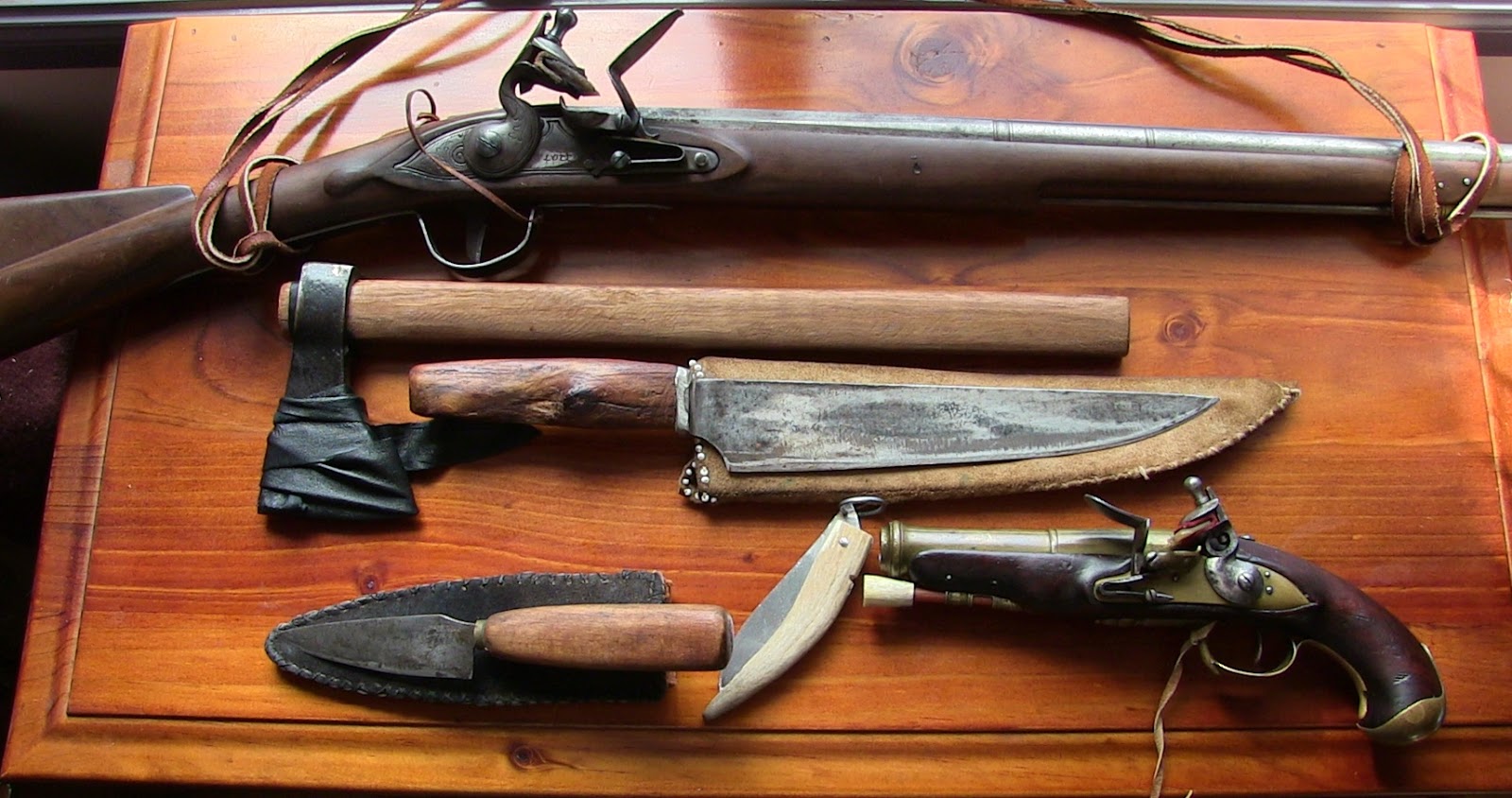
My .62 caliber/20 gauge smoothbore flintlock fusil with a 42 inch barrel.


My .70 caliber smoothbore flintlock pistol.


My .32 caliber flintlock rifle.

If you have any modern breach-loading guns, & you have extra people to carry them, then I recommend taking them but keep them for self-defence ONLY. If you use them for hunting as well as protection, you will soon run out of ammunition.


Monday, June 29, 2015

Ignorance Of Firearms In The Australian Police Service & The Anti-Gun Lobby Is Rife.


For those of you who are not familiar with any firearms other than police service guns, like the police, this rifle shown in the video is in fact a bolt action. An automatic IS a machine gun!!! A bolt action is NOT a semi-auto either!!! These are the sort of ignorant people we legal gun owners have to deal with in the police service & within the anti-gun lobby. They have absolutely no idea what they are talking about.
Keith.