Rice 101: Nutrition Facts and Health Effects.
Showing posts with label long term. Show all posts
Tuesday, August 1, 2017
Dry Foods For Storing & Carrying. What About Rice?
Labels:
bugging out,
dried foods,
long term,
Nutrition,
pantry,
preppers,
prepping,
preservation,
retreat,
Rice,
SHTF,
storage,
survival,
TEOTWAWKI,
trail foods
Location:
Australia
Wednesday, December 28, 2016
Disaster Preparedness for the Apocalypse: How to Prepare for any Disaster.
Cyclone Tracey 1974 Darwin Australia.
Check out this blog: http://www.sheepdogman.com/disaster-preparedness-essentials#
Location:
Australia
Tuesday, December 20, 2016
NASA scientist: Earth is overdue a dinosaur-killing asteroid strike, and we're woefully unprepared.
NASA scientist: Earth is overdue a dinosaur-killing
asteroid strike, and we're woefully unprepared.
Labels:
Asteroid,
collision,
devastation,
earth,
long term,
preppers,
prepping,
SHTF,
survival,
survivalists,
TEOTWAWKI
Location:
Australia
Friday, November 11, 2016
Natural Herbal Pain Killers.
Labels:
gardens,
growing,
herbs,
homesteading,
long term,
natural,
pain killers,
preppers,
prepping,
retreat,
survival,
sustainable,
wilderness living
Location:
Australia
Thursday, October 20, 2016
What Skills Will Allow You To Do & Not Do.
Medical Kit.
Medications.
Food bags & containers.
Water bottles or flasks.
Tools for hunting & defence.
Shelter & bedding.
What Skills Will Allow You To Do & Not Do.
The debate regarding equipment versus skills is ongoing, in my
personal opinion, both are of equal importance. We are not just talking about survival;
we must also be concerned with our quality of life. Yes learning primitive
skills for long term survival are very important, but you have to think about
what these skills can provide you with & what they can’t. For instance, if
you need to cook a stew, then you need a fireproof container. You could
experiment making clay vessels, you can also use animal skins & use the hot
rock method. But how much easier is it to carry a metal kettle with you?
So why am I mentioning this? I am mentioning this because weight
matters if you have to carry it on your back when travelling on foot. There has
to be some compromise between two principles, minimum weight & maximum
self-reliance. When people are asked about the hunting tools/weapons, top of
the list is usually high powered breech-loading firearms. These are fine for
self-defence, but how practicle are they for long term survival? The larger the
caliber, the more the ammunition weighs, & the more space in your pack
it takes up. We need to prioritise, is it more important to carry a lot of
weight in modern ammunition? Or is it more important to carry more medical
equipment & supplies, vitamin supplements, more food & more water? If we are travelling alone, we can not
carry both.
If we are only carrying a modern firearm & we intend to use it
for hunting & defence, then the ammunition will not last long. We can of
course avoid a fire fight by keeping a low profile, & we can save on
ammunition by setting up a trap line for meat. But how secure will you feel
knowing that when your ammunition runs out, you will be left with nothing with
which to defend yourself or procure game? Your alternatives are: carrying an
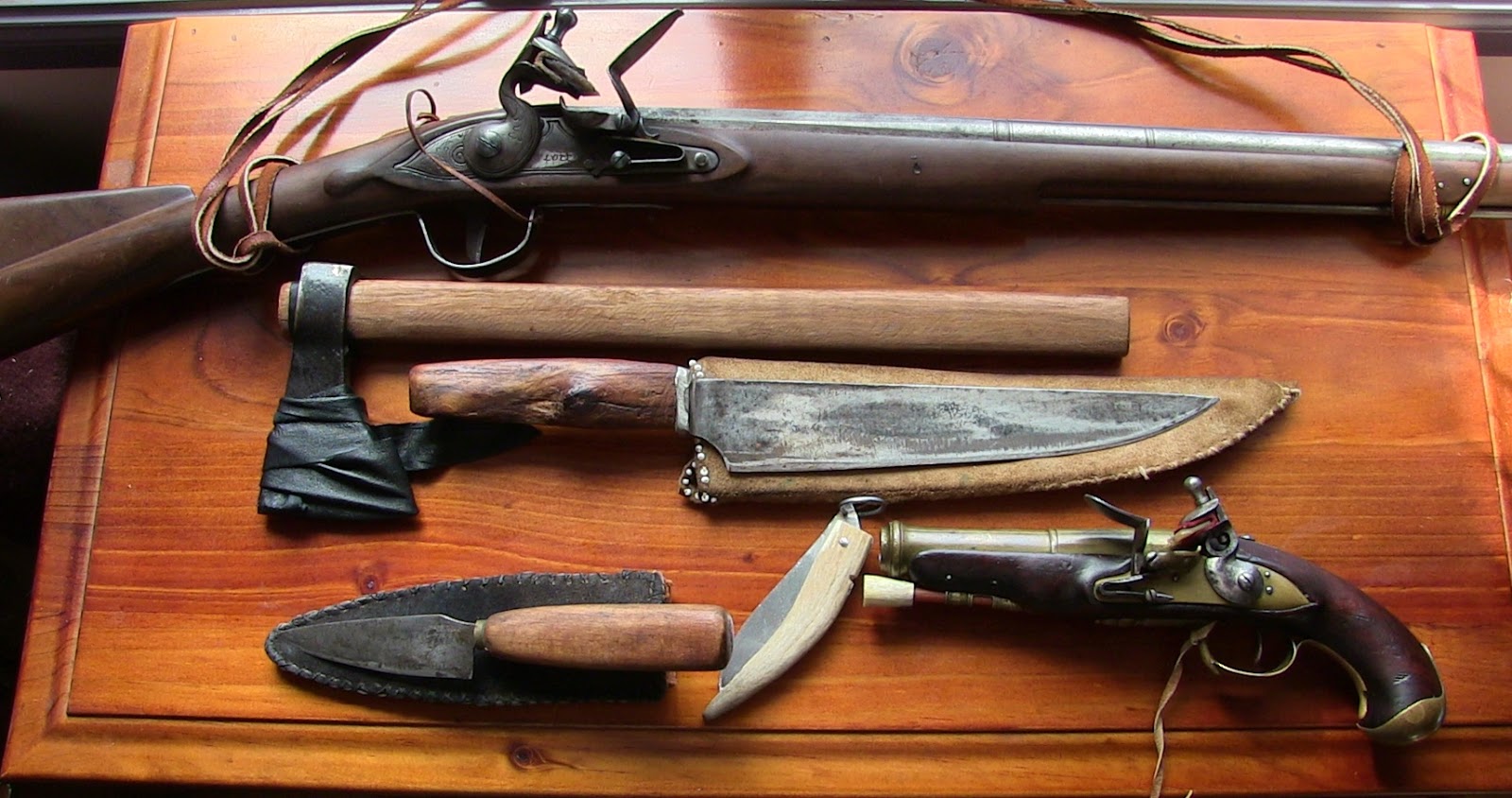
air rifle, carrying a traditional bow & arrows, or carrying a flintlock
muzzle-loading gun/rifle & pistol. Another alternative for those in America
might be to carry a modern sidearm in combination with one of the
aforementioned hunting tools, or carry a bow & a modern firearm.
Weight is the all important factor, that & sustainability. Solid
form medications have a long shelf life, so we need to take advantage of this.
Dry foods too have a long storage capability & it is important that we
carry as much food as we can. Eventually we hope to be able to take the time to
forage for edible flora & hunt & trap game, but until that time comes,
we are on the move & we need to keep a low profile.
Can primitive skills supply you with medications? Yes of course they
can, but finding the herbs you need will not be easy, & especially so if
you are already feeling ill. We need to think about our well being, our
comfort. Any item that is sustainable & will make life easier is worth
carrying, within reason. Skills will enable you to make a survival bow &
arrows, but if you should ever come up against someone with a gun, you may have
some difficulty surviving. Something that people often fail to take into
account is the shock factor of a firearm, the noise & the impact of the
missile. A bow against a firearm can not deliver this.
Anyway, the purpose of this article is to make you think before you
leap. Think about the equipment you are going to carry & how it will best
benefit your survival physically & mentally. Learn all you can about
primitive skills, & if you plan to survive on your own retreat, then think
about the living skills you will need to keep things in good repair.
When it comes to transporting equipment on foot, you can use a hiking
trolley, but like all forms of transport from vehicles to animals, there will
always be a negative side. The tracks you will leave to be followed, the places
you can’t go, the noise you will make.
Labels:
ammunition,
bows,
carrying,
defence,
equipment,
gear,
guns,
living skills,
long term,
preppers,
prepping,
primitive skills,
rifles,
survival,
sustainability,
tools,
trekking,
weapons,
weight
Location:
Australia
Friday, March 25, 2016
Useful Information For On The Trail.
Not all of this will be relevant to your situation should you have to leave your home if or when the SHTF. But modern guerrilla warfare was based on the following 18th century rules, & I think they are worth taking note of.
Keith.
Rogers Rangers
Standing Orders 1759.
1. Don't forget
nothing.2. Have your musket clean as a whistle, hatchet scoured, sixty rounds powder and ball, and be ready to march at a minute's warning.
3. When you're on the march, act the way you would if you was sneaking up on a deer. See the enemy first.
4. Tell the truth about what you see and what you do. There is an army depending on us for correct information. You can lie all you please when you tell other folks about the Rangers, but don't never lie to a Ranger or officer.
5. Don't never take a chance you don't have to.
6. When we're on the march we march single file, far enough apart so one shot can't go through two men.
7. If we strike swamps, or soft ground, we spread out abreast, so it's hard to track us.
8. When we march, we keep moving till dark, so as to give the enemy the least possible chance at us.
9. When we camp, half the party stays awake while the other half sleeps.
10. If we take prisoners, we keep 'em separate till we have had time to examine them, so they can't cook up a story between 'em.
11. Don't ever march home the same way. Take a different route so you won't be ambushed.
12. No matter whether we travel in big parties or little ones, each party has to keep a scout twenty yards ahead, twenty yards on each flank and twenty yards in the rear, so the main body can't be surprised and wiped out.
13. Every night you'll be told where to meet if surrounded by a superior force.
14. Don't sit down to eat without posting sentries.
15. Don't sleep beyond dawn. Dawn's when the French and Indians attack.
16. Don't cross a river by a regular ford.
17. If somebody's trailing you, make a circle, come back onto your own tracks, and ambush the folks that aim to ambush you.
18. Don't stand up when the enemy's coming against you. Kneel down, lie down, hide behind a tree.
19. Let the enemy come till he's almost close enough to touch. Then let him have it and jump out and finish him with your hatchet.
Sunday, February 14, 2016
If or When TSHTF. Part Six. Going Bush. Gardening & Construction Tools.
Gardening and Construction Tools.
When moving out bush with a view to long term living you
need to have some idea in your head as to the type of area you are looking for.
You will need permanent water if possible, a creek or a river. This may also
supply reeds for shelter construction & other items. A cave would make a
great shelter or even a rock shelter, but if these are not available at your
water source then you will have to construct shelters.
These types of tools are generally bulky & heavy, but
they can also double as weapons if you have people to carry them. Helves, handles
& stails can be removed from the heads & the heads can be carried in a
pack if this is easier than carrying the complete tool. Think carefully about the
tools you will need. In a long term wilderness living situation you will need
to produce gardens & construct shelters.
Here is a list of tools that I have collected for this
purpose:
·
Felling axe
·
Small shovel
·
Small mattock/pick
·
Sickle or sword
·
Hoe
·
Auger
·
Gimlet
·
Pruning saw
This is what we call Cattail Pond. It is large & deep & is fed from a header stream. Cattails/Cumbungi provide food & materials for roofing, mat making, mulch for gardens & arrow shafts.
This is a small mattock/pick head made to be used with a short helve for one handed use. But you can make & fit a longer helve (handle).
Full sized 18th century style garden hoe.
Large auger for cutting holes & hammering in wooden pegs for securing beams together or just installing pegs.
An original 18th or 19th century pick.
Pruning saw. These are very efficient for cutting off tree limbs & for construction work. Easily carried if you construct a sheath, or just wrap & place in a pack.
18th century sickle for cutting reeds.
This is a small shovel head that I can easily carry in my pack & make & fit a handle when I reach my destination.
My hunting sword. A weapon & a useful tool for cutting reeds.
Left to right: My felling axe with a light head & a straight helve; two fascine knives or bill hooks; an adze; my half-axe which I occasionally carry tied to my pack, & my tomahawk which I carry in my belt at all times.
These are a small auger & gimlet that I made from two brace bits.
Above you can see how I hammered the ends with a ball peen hammer to secure the bits in the handles that I made.
Two original gimlets. In the 18th century these were used to make holes for nails so that the nails would not split the wood. Later they were still in use for making holes for wood screws. These can also be used to make holes for wooden pegs or for inserting wire for repairs or construction.
Seeds
You will need to take seeds with you so now is probably a good time to be collecting them. If they go out of date before use, replace them. You should have some idea of the area you will be travelling to, so purchase seeds for that climate. Following is a list of what we grow in the New England area:
·
Pumpkin/squash
·
Zucchini marrow
·
Silverbeet
·
Chard
·
Sunflowers
·
Corn
·
Potatoes
·
Tomatoes
·
Jerusalem Artichokes
You will never starve if you are growing Jerusalem
Artichokes. These are a root crop which last through winter & continue to grow
when warmer weather comes. They are related to the sunflower .
Jerusalem Artichoke tubers
This image showing my half-axe secured to my blanket roll by simply sliding the helve under the ties. I can carry the large auger in the same manner.
Saturday, February 13, 2016
If or When TSHTF Part Five. My choice of the best gun for long term wilderness living. The Muzzle-Loader.
Any muzzle-loader will give you an edge in long term wilderness living except the percussion lock. The percussion lock, also known as a caplock, requires fulminate of mercury caps for its ignition. This method is NOT sustainable. Tinderlocks & Matchlocks are good but they require a burning fuse at all times making you visible in the dark & the gun not so pleasurable to use as other later locks. The wheellock is good but does require Pyrite for its ignition & this is not always easy to find.
The flintlock requires a siliceous or igneous rock for ignition & this type of rock can be found in the bush if you know what you are looking for. I find the easiest way is to carry a fire steel with you & simply test the rocks you come across to see if they are hard enough to create sparks by striking the steel.
Above: This is English flint, a siliceous rock which can occasionally be found in coastal areas of Australia where English ships dumped their flint rock ballast before taking on a new cargo.
Above: This is agate which can be very common in places in Australia. Agate was used a lot in place of flint for flint & steel fire lighting. Agate is also a siliceous rock.
Above: This is quartz, very common in places & although it tends to fracture easily it is still a good rock to use for gun or fire lighting.
Above: Green chert.
http://www.aradon.com.au/green_chert.html;
Jasper.
This is obsidian, an igneous rock or volcanic rock.
Advantages of A Flintlock Muzzle-loader.
1) Ammo is less expensive than a modern equivalent caliber firearm.
2) The smoothbore is very versatile, being able to digest round ball, bird
shot, & buckshot, or any combination of two of these (can also use minies).
3) The fusil is lighter to carry than a modern equivalent sized gun.
4) You can vary the load if needs be.
5) The smoothbore will digest other projectiles besides lead.
6) Lead can be retrieved from downed game & remoulded with a simple
mould & lead ladle. This means that you can carry less lead, & more of
the lighter gunpowder.
7) You can make your own gunpowder.
8) You can use the lock to make fire without the need for gunpowder.
9) You can use gunpowder for gunpowder tinder fire lighting if needs be.
10) IF the lock should malfunction
(these are very robust & it is not likely) you can easily repair it if you
are carrying a few spare springs & a few simple tools.
11) If you do not have any spare parts & the lock malfunctions, you can
easily convert it to a tinderlock or matchlock & continue using it.
12) You do not need a reloader, brass shells, caps, or primers. The latter
have been known to break down in damp conditions or if they are stored for too
long.
13) Wadding for ball or shot is
available from natural plant materials or homemade leather or rawhide.
14) Less chance of being affected by future ammunition control legislation.
15) Gunpowder is easily obtainable providing you have a muzzle-loader
registered in your name regardless of caliber (only NSW is looking at this
legislation at present).
16) A .32 caliber flintlock rifle is more powerful than a .22 rimfire, less
expensive to feed, more accurate over a greater distance, able to take small
& medium sized game, & other than not being able to use shot (unless it
is smoothbore), it has all the attributes of the other flintlocks.
17) Damage from a .62 caliber-.75 caliber pistol or long arm is in the
extreme. Wounded prey is unlikely to escape.
18) By using buck & ball you are
unlikely to miss your target. This load is capable of taking out more than one
target.
19) There is less kick-back to a
muzzle-loading gun.
20) Antique Flintlock muzzle-loading
guns do not require a license, registration, or a permit to purchase in NSW
Australia.
My .62 caliber/20 gauge smoothbore flintlock fusil with a 42 inch barrel.
My .70 caliber smoothbore flintlock pistol.
My .32 caliber flintlock rifle.
If you have any modern breach-loading guns, & you have extra people to carry them, then I recommend taking them but keep them for self-defence ONLY. If you use them for hunting as well as protection, you will soon run out of ammunition.
Labels:
flintlock,
foraging,
guns,
hunting,
igneous,
living,
long term,
muzzle-loaders,
obsidian,
pistols,
prepper,
prepping,
rifles,
rocks,
siliceous,
smoothbore,
survival,
survivalists,
wilderness
Location:
Australia
If or When TSHTF Part Four. Primitive living/survival skills.
This is a basic list of skills for woodsrunners in our group. These are long term wilderness living/survival skills.
Woodsrunner’s
Skills.
This is a list
of basic skills in which I personally would expect an 18th century
woodsman or woods-woman to have some experience with in our group.
·
Flint &
steel fire lighting
·
Wet weather fire
lighting
·
Fire-bow fire
lighting
·
Flintlock fire
lighting
·
Flintlock use,
service & repair
·
Marksmanship
with either gun or bow.
·
Field dressing &
butchering game
·
Blade sharpening
·
Tomahawk
throwing
·
Making rawhide
·
Brain tanning
·
Primitive
shelter construction
·
How to stay warm
in winter with only one blanket
·
Cordage
manufacture
·
Moccasin
construction and repair
·
Sewing
·
Axe and tomahawk
helve making
·
Fishing
·
Hunting
·
Evasion
·
Tracking
·
Reading sign
·
Woods lore
·
Navigation
·
Primitive trap construction
& trapping
·
Open fire
cooking
·
Fireplace
construction
·
Clothing
manufacture
·
Drying meat
& other foods
·
Knowledge of
plant tinders & preparation
·
Knowledge of
native foods & preparation
·
Knowledge of
native plants in the area and their uses for other than tinder and food.
·
Scouting/Ranging.
·
Basic first aid.
·
Finding and
treating water.
·
General leather
work.
Labels:
18th century,
bush,
firearms,
flint & steel,
guns,
living,
living history,
long term,
making clothing,
making fire,
plant tinders,
preppers,
prepping,
primitive,
skills,
survival,
survivalists,
trekking,
wilderness
Location:
Australia
Subscribe to:
Posts (Atom)