The Advantages of Carrying/Using 18th Century
Equipment.
·
A flintlock smoothbore gun is
versatile, you can make fire with the lock without using any gunpowder, you can
use various sizes of small shot & round ball, you can if necessary use
other projectiles besides lead, you can retrieve lead from shot game &
remould it for further use. If the lock should malfunction it is easily
repaired with spare springs, if you have no spare springs the lock is easily
converted to matchlock.
·
A flintlock rifle has the same
advantages as the smoothbore except that it can not use small shot without
leading the barrel. A .32 flintlock rifle has more power than a .22 rimfire
& is less expensive to shoot.
·
You can purchase an antique
flintlock pistol now with no need for licence or registration.
·
Ball moulds can be used as heavy
tweezers for removing foreign objects from the body.
·
Gunpowder (Black Powder) can be
used to make fire with unprepared plant tinders without wasting ammunition.
·
A trade axe/tomahawk is very
versatile. The head is easily removed to be used as a hide scraper, the
tomahawk can be thrown for recreation, self defence & hunting. This axe is
a good defence weapon for hand to hand fighting, for constructing shelters
& traps & for hammering in stakes or wooden pegs. A new helve/handle is
easy to make & fit & does not require a wedge to secure the head.
·
The awl is used for making
leather items & for repairing leather items. The awl is used to make &
repair moccasins.
·
The butcher knife is for skinning
& butchering game & can be used for self-defence.
·
The legging knife is a back-up to
the butcher knife. If you should dull the edge on your butcher knife you can
continue with the legging knife. You do not want to stay around sharpening
blades. Your shot may have attracted unwanted attention.
·
The clasp knife is used for camp
chores & for making trap triggers. You do not want to use your main blades
as utility knives.
·
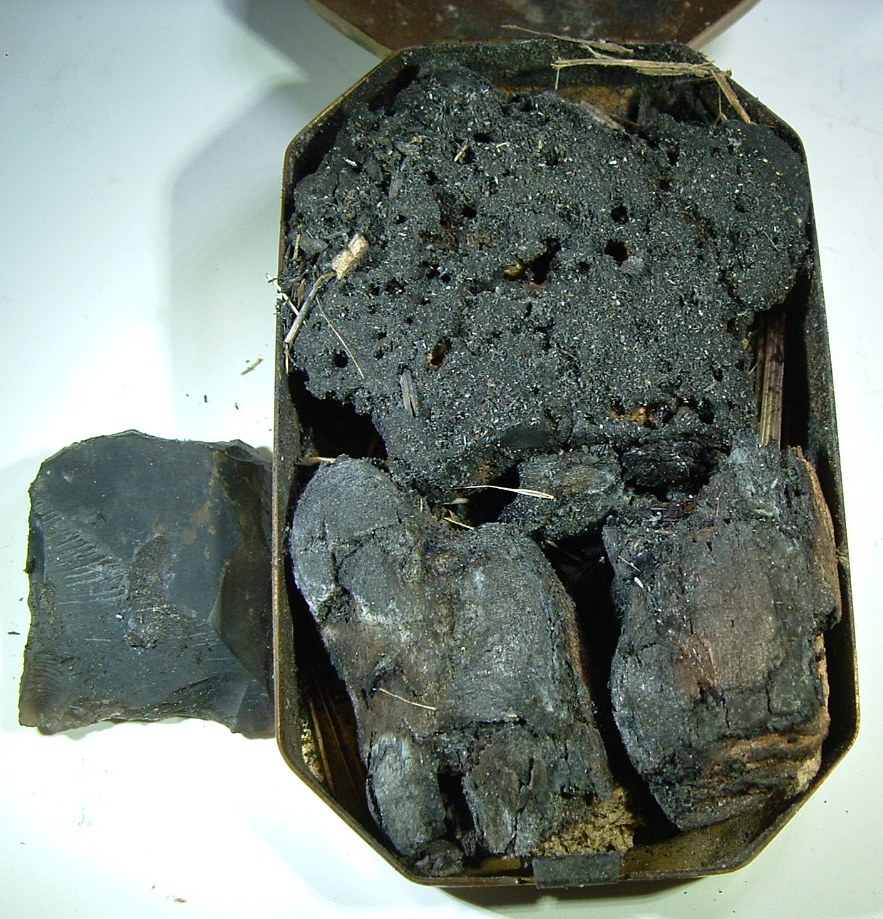
Flint, steel & tinderbox will
enable you to make fire anywhere in all weathers. It will not break or wear out
& the process is renewable & sustainable.
·
18th century woodsrunner’s
clothing (men & women) is practicle, protective, hard wearing &
renewable.
·
The housewife (sewing kit) is for
making & repairing clothing & packs. The needles can be used for
removing splinters & if needs be sewing up wounds. The beeswax is used to
wax the linen sewing thread & can be used as makeshift tooth fillings.
·
The angling tackle can be used
with a rod or set lines, it can also be used for catching ducks & large
land fowl. The linen or silk lines can be replaces with hand made cordage made
from plant materials. Silk lines can be used as suture thread.
·
The cooking kettle is used for
boiling food, boiling water for drinks & sterilising, carrying water &
for catching rainwater.
·
Cotton & linen bags can be
used for cleaning dirty water before boiling for drinking or adding to your
water bottle.
·
Gun tools are used for repairing
the lock on your flintlock muzzle-loading gun if needs be, but these locks are
very hard wearing. The tools are merely a back-up. The turn screw is used to
remove the lock & barrel for cleaning.
·
The whet stone is used to sharpen
your blades, as is the metal file though both could have other uses if working
with metal.
·
The half-axe is optional & is
capable of heavier work than the tomahawk without adding too much weight.
·
An auger is optional & is
used for making holes for constructing more permanent dwellings. These augers
come in a variety of sizes & weigh very little. Small versions will fit in
your pack, where longer versions can be tied to your blanket roll.
·
The sword is also optional but in
a hand to hand fight can be very useful. The sword is also used for cutting
reeds for shelter & mat construction.
·
The wool blanket is far more
versatile than a sleeping bag, & if wet the blanket retains more body heat
than a sleeping bag. The pure wool blanket can be used as a matchcoat or a
Great Coat & can be used in a sitting position under an oilcloth covering
on the trail.
·
The oilcloth shelter is very
versatile & can be used in many ways, including use as a rain coat. Used as
a lean-to shelter you can use fire for warmth at night & you have good
visibility on at least three sides. The lean-to is easy & quick to
construct & quickly taken down. It does not need tent poles/rods & it
is easy to carry.
Anyone using this equipment is advised to learn the
many primitive skills that go with this type of wilderness living. If you are
living this 18th century lifestyle then your level of comfort will
never drop below this level. This equipment does not wear out, anything that
should break can be repaired or replaces from natural sources. You are also
advised to carry a modern medical kit which should include an eye wash glass.