Showing posts with label gardening. Show all posts

Saturday, February 8, 2020

Anthropogenic Global Warming & the Garden!

Last year was pretty much a disaster, & this year has started in the same vein. The leaves of vegies burning in the sun, losing much of our fruit due to a warm winter, then the drought & running low on water & then the threat of bushfires. So, we have been making changes in the garden. We know that anthropogenic global warming is going to get worse, so we are preparing for the present & hopefully the future. Our grandchildren may not survive global warming, but hopefully we can help them survive teotwawki.

One of our galvo water tanks up at the cottage was leaking, so I cut it into three sections & made three raised garden beds. Whilst cleaning up the cottage garden area one of my sons decided to get rid of the old water tanks being used to store firewood, so that has produced another three raised garden beds. A small tank that I was thinking of repairing also got converted into two more smaller raised garden beds because we decided to install two more new 1000 gallon water tanks for the garden. We used to pump water from the big dam for the gardens at the cottage & the main house, but for the first time in 30 odd years, this dam became almost dry. We decided to preserve what was left for the local wildlife & for fire fighting if needs be. Fortunately though the fires were all around us & we were enveloped in heavy smoke for weeks, the fires never reached our forest.
Five tank raised garden beds & the sand pit for our grandchildren.
The first raised garden bed I made from old roofing iron & four posts.

My second design for a raised garden bed using pallets cut in half & old roofing iron.
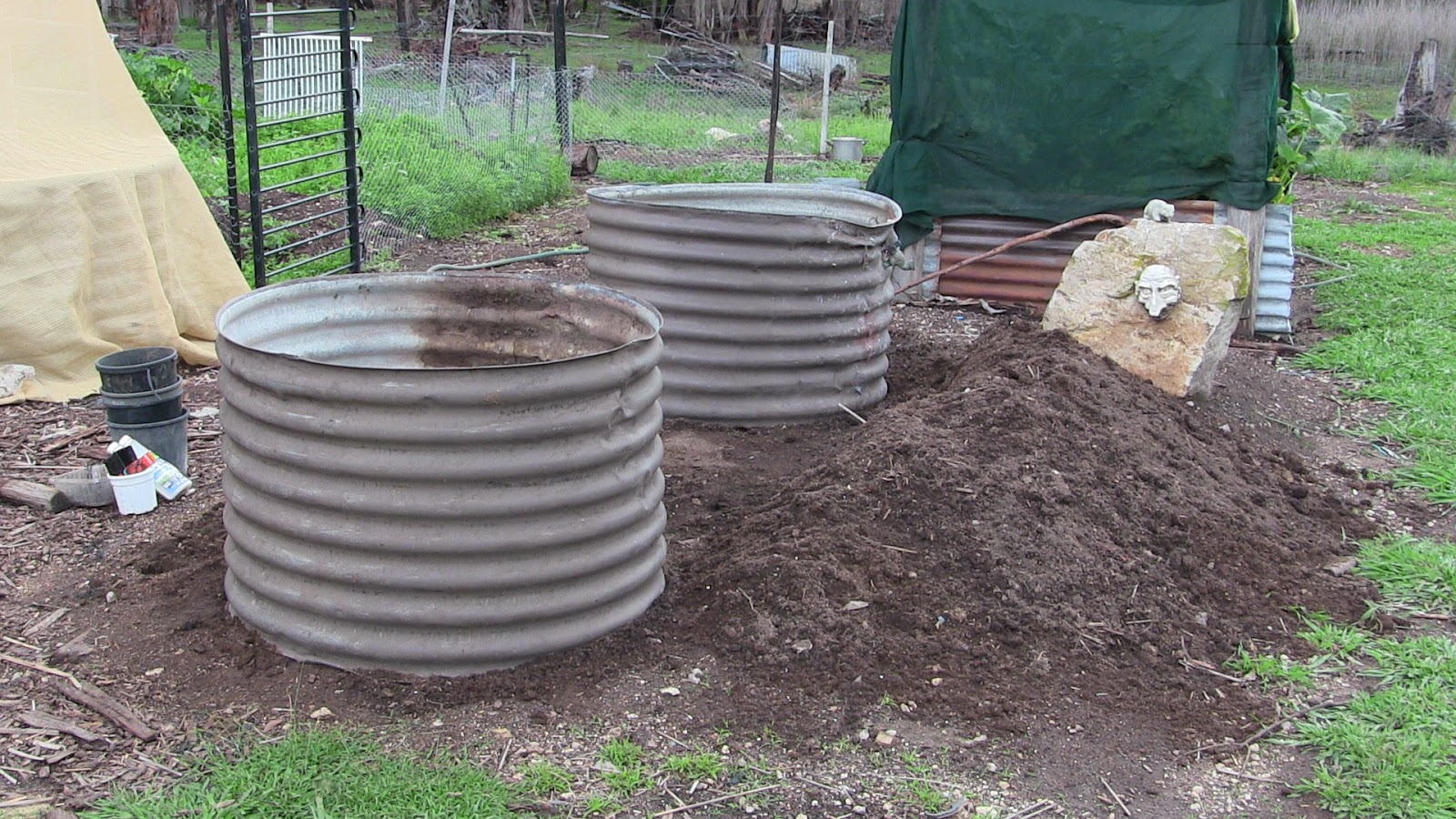
The latest raised garden bed additions, smaller but still useful. The advantages of these raised garden beds is that I think they will retain moisture better, they are easier to shade, easier to weed if needed, the bed is better secured & can not spread onto the paths, & it keeps the ducks out!!!
Well it's a bird bath right? And I am a bird right?

One new water tank on the left installed, we are still waiting on the second one to arrive. Since the drought everyone has been ordering more water tanks.
Keith.


Monday, November 5, 2018

Making Our Own Mulch. Global Warming & Hotter Weather using too much water!


With the weather being much hotter here now we have had to use a lot of shade cloth & mulch. Purchasing mulch is expensive these days, the reason for that can probably be blamed on Global Warming too! So we decided to make our own mulch, we have been cutting the reeds down at Cattail Pond whilst the water level is low (!), & carting it up to the gardens to use as mulch. Some we use as is where we can, the rest we run through or mulcher. It works well & makes great mulch.


Sunday, February 14, 2016

If or When TSHTF. Part Six. Going Bush. Gardening & Construction Tools.


Gardening and Construction Tools.
When moving out bush with a view to long term living you need to have some idea in your head as to the type of area you are looking for. You will need permanent water if possible, a creek or a river. This may also supply reeds for shelter construction & other items. A cave would make a great shelter or even a rock shelter, but if these are not available at your water source then you will have to construct shelters.
These types of tools are generally bulky & heavy, but they can also double as weapons if you have people to carry them. Helves, handles & stails can be removed from the heads & the heads can be carried in a pack if this is easier than carrying the complete tool. Think carefully about the tools you will need. In a long term wilderness living situation you will need to produce gardens & construct shelters.
Here is a list of tools that I have collected for this purpose:
·    Felling axe
·    Small shovel
·    Small mattock/pick
·    Sickle or sword
·    Hoe
·    Auger
·    Gimlet
·    Pruning saw

This is what we call Cattail Pond. It is large & deep & is fed from a header stream. Cattails/Cumbungi provide food & materials for roofing, mat making, mulch for gardens & arrow shafts.

This is a small mattock/pick head made to be used with a short helve for one handed use. But you can make & fit a longer helve (handle).

Full sized 18th century style garden hoe.

Large auger for cutting holes & hammering in wooden pegs for securing beams together or just installing pegs.

An original 18th or 19th century pick.

Pruning saw. These are very efficient for cutting off tree limbs & for construction work. Easily carried if you construct a sheath, or just wrap & place in a pack.

18th century sickle for cutting reeds.


This is a small shovel head that I can easily carry in my pack & make & fit a handle when I reach my destination.

My hunting sword. A weapon & a useful tool for cutting reeds.

Left to right: My felling axe with a light head & a straight helve; two fascine knives or bill hooks; an adze; my half-axe which I occasionally carry tied to my pack, & my tomahawk which I carry in my belt at all times.

These are a small auger & gimlet that I made from two brace bits.


Above you can see how I hammered the ends with a ball peen hammer to secure the bits in the handles that I made.

Two original gimlets. In the 18th century these were used to make holes for nails so that the nails would not split the wood. Later they were still in use for making holes for wood screws. These can also be used to make holes for wooden pegs or for inserting wire for repairs or construction.

Seeds
You will need to take seeds with you so now is probably a good time to be collecting them. If they go out of date before use, replace them. You should have some idea of the area you will be travelling to, so purchase seeds for that climate. Following is a list of what we grow in the New England area:
·    Pumpkin/squash
·    Zucchini marrow
·    Silverbeet
·    Chard
·    Sunflowers
·    Corn
·    Potatoes
·    Tomatoes
·    Jerusalem Artichokes
You will never starve if you are growing Jerusalem Artichokes. These are a root crop which last through winter & continue to grow when warmer weather comes. They are related to the sunflower .

Jerusalem Artichoke tubers


This image showing my half-axe secured to my blanket roll by simply sliding the helve under the ties. I can carry the large auger in the same manner.